
You Don’t Rise to the Occasion, You Default to Your Training
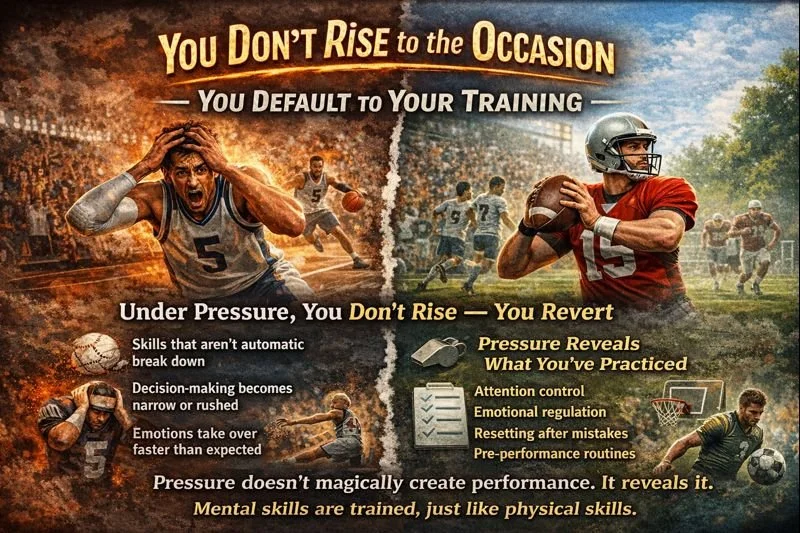
When pressure hits, athletes often tell themselves they’ll step up. That somehow, in the biggest moments, they’ll dig deeper, focus harder, and perform better than ever before.It’s a powerful idea — and a common one. But performance science tells a different story.
Under Pressure, You Don’t Rise — You Revert
In high-stress moments, athletes don’t suddenly access new skills or better decision-making. They default to what’s most familiar. When the nervous system senses threat, competition, expectations, consequences, the brain shifts into efficiency mode. There’s no room for conscious problem-solving or experimentation. The body and mind go straight to what’s been practiced most.
That’s why under pressure we often see:
Skills that aren’t automatic break down
Decision-making becomes narrow or rushed
Emotions take over faster than expected
This isn’t a failure of character. It’s a reflection of training.
Physical Skills Are Trained for Pressure — Mental Skills Often Aren’t
Athletes spend countless hours making physical skills automatic.
Repetition. Drills. Game-speed practice.
Mental skills, on the other hand, are often left to chance. Yet mental training is just as trainable and just as essential.
Mental skills include:
Attention control
Emotional regulation
Resetting after mistakes
Pre-performance routines
Managing internal dialogue
When these skills aren’t trained, pressure doesn’t create problems — it exposes gaps. Not gaps in talent, but gaps in preparation.
This Isn’t About Being “Mentally Tough”
Athletes who perform consistently under pressure aren’t calmer by nature. They aren’t immune to stress. They aren’t built differently. They're more practiced at responding to stress. They’ve trained:
What they focus on when things speed up
How they reset after errors
How they respond to frustration, doubt, or momentum shifts
* Their nervous system recognizes pressure because it’s been there before — in training.
Pressure Reveals What You’ve Practiced
Pressure doesn’t magically create performance. It reveals it. Mental skills aren’t optional or “extra.” They’re part of the performance system — just like strength, conditioning, and technical skill.
If you want reliability under pressure, you don’t hope for it. You train for it.
