
You’re Not Lazy: Why Focus Works Differently in ADHD
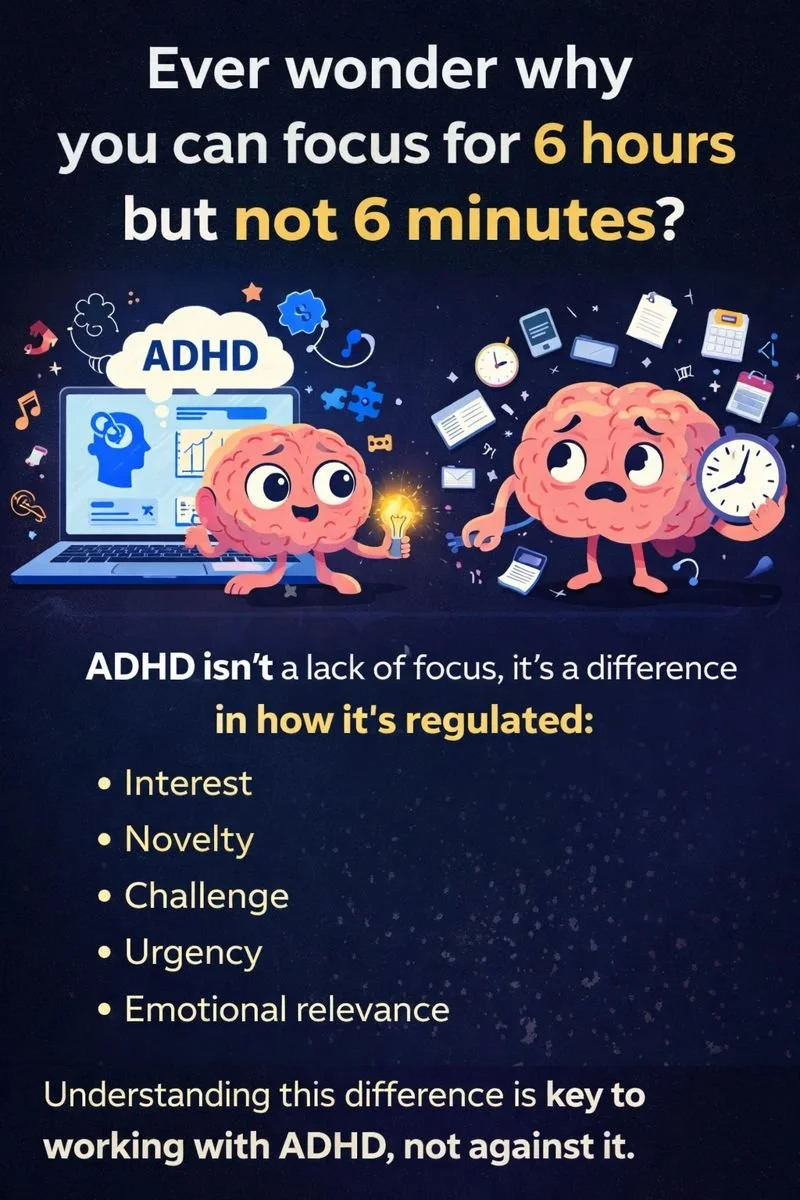
Why you can focus for 6 hours on one thing—and not 6 minutes on another
If you have ADHD, you’ve probably heard some version of this before:
"If you can focus on that, you could focus on anything if you really tried."
ADHD isn’t a lack of focus.
It’s a difference in how focus is regulated. Understanding this difference—rather than judging it—can fundamentally change how you work, learn, train, and live.
ADHD Is an Interest-Based Nervous System
Most people are taught that motivation follows importance:
Do what matters first.
ADHD doesn’t work that way. ADHD is best understood as an interest-based nervous system, not a priority-based one. Attention is more reliably activated by:
Interest
Novelty
Challenge
Urgency
Emotional relevance
This is why someone with ADHD might:
Hyperfocus for hours on a project, game, or topic they care about
Struggle to start or sustain attention on tasks that feel boring, repetitive, or low-reward—even when those tasks are important
This isn’t laziness or defiance. It’s neurobiology.
The Role of Dopamine: Motivation Comes Before Action
To understand why interest matters so much, we need to talk about dopamine.
Dopamine is often called the “reward chemical,” but it’s more accurate to think of it as the motivation and engagement neurotransmitter.
In ADHD:
Dopamine signaling tends to be lower or less consistent in key brain networks
This makes it harder to initiate tasks that don’t offer immediate stimulation or payoff
Once interest or urgency kicks in, focus can lock in intensely (hyperfocus)
This explains why ADHD brains often respond well to:
Novelty (something new or different)
Urgency (deadlines, pressure, competition)
Immediate feedback or rewards
External structure rather than internal willpower
The brain isn’t refusing to cooperate—it’s waiting for enough stimulation to engage.
Why “Just Try Harder” (and Shame) Makes It Worse
When ADHD is misunderstood, people internalize messages like:
“I’m lazy”
“I should be able to do this”
“Something is wrong with me”
Shame increases stress, and stress further impairs:
Executive functioning
Emotional regulation
Working memory
Task initiation
In other words, shame activates the very conditions that make ADHD symptoms worse. Research consistently shows that self-criticism does not improve motivation in ADHD. Compassion, understanding, and appropriate supports do.
Working With an ADHD Brain (Not Against It)
When you understand how ADHD actually works, strategies shift from forcing compliance to designing environments that support engagement:
Externalizing structure (timers, reminders, visual cues)
Breaking tasks into dopamine-accessible steps
Pairing boring tasks with stimulation
Using values, meaning, and interest to guide effort
Reducing shame and increasing curiosity
The goal isn’t to “fix” the brain.
It’s to build systems that fit the brain you have.
Understanding Your Brain Changes How You Work With It
ADHD is not a character flaw.
It’s not a lack of discipline.
And it’s not a failure of effort.
It’s a different operating system—one that can be incredibly creative, focused, and effective when understood and supported.
When you understand your brain, you stop fighting it—and start working with it
