
Why routines help ADHD- and why they’re so hard to keep
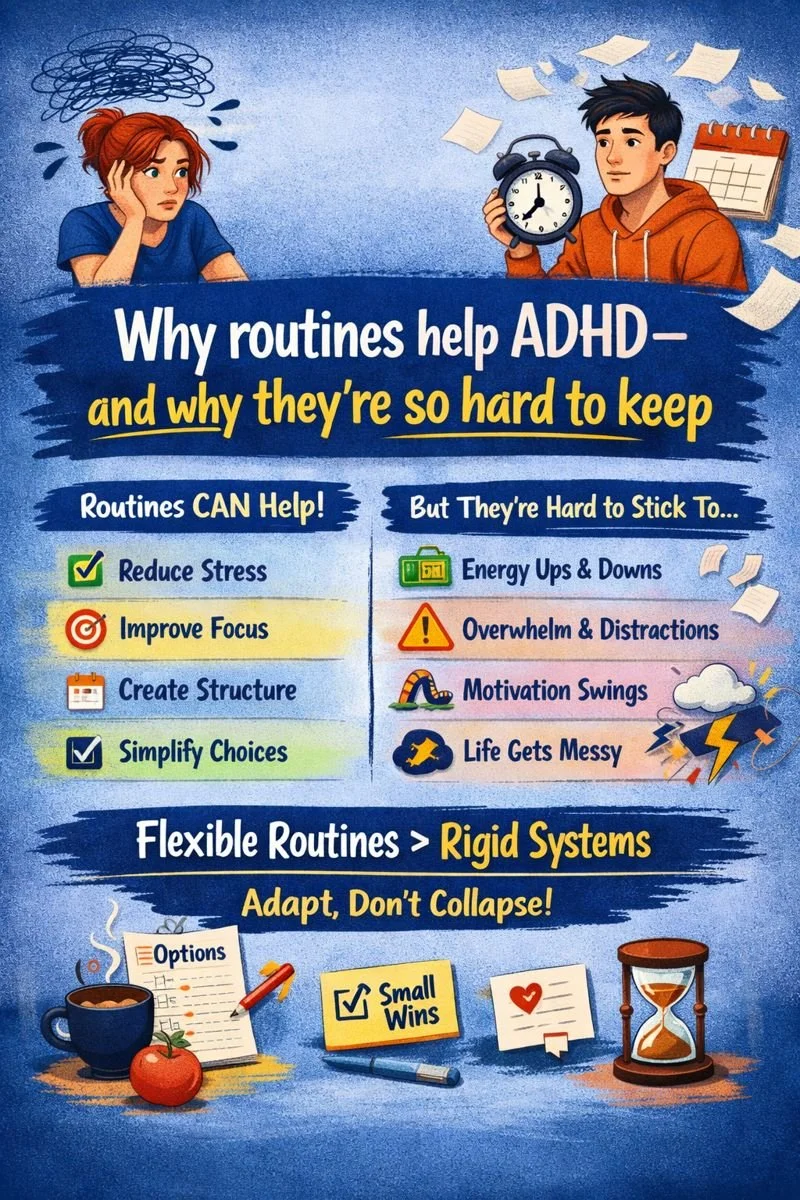
If you live with ADHD, you’ve probably heard some version of this advice more times than you can count:
“You just need a better routine.”
And maybe you’ve tried. Morning routines. Night routines. Colour‑coded planners. Apps. Alarms. Systems that worked beautifully… for about three days.
If routines feel helpful and impossible at the same time, you’re not broken — and you’re not failing. There’s a reason this keeps happening.
Why routines do help ADHD
At their best, routines reduce decision fatigue. They free up mental energy. They create predictability in a nervous system that’s often running hot.
For ADHD brains, routines can:
Lower stress by reducing constant “what should I do next?” thinking
Support memory and follow‑through
Create anchors in the day when attention feels scattered
Make hard tasks feel more doable because the starting point is clearer
So yes — routines can be incredibly supportive.
So why are they so hard to keep?
Because most routines are designed for consistency, not capacity.
Many people with ADHD don’t struggle because they lack motivation or discipline. They struggle because:
Energy levels fluctuate wildly day to day
Focus comes in waves, not on command
Executive functioning drops under stress, overwhelm, or fatigue
Life rarely cooperates with rigid plans
When routines are built like rules — same time, same order, every day — they often collapse the moment life shifts. And when they collapse, shame usually follows.
That shame can sound like:
“Why can’t I just stick with something?”
But the problem isn’t you. It’s the system.
Routines vs. rigid systems
A helpful distinction:
Rigid systems demand compliance. Supportive routines adapt to reality.
Rigid systems:
Assume stable energy and focus
Break when one step is missed
Create an all‑or‑nothing mindset
Often lead to avoidance after a slip
Flexible routines:
Expect inconsistency
Allow for adjustment
Offer structure without punishment
Can be returned to without starting over
For ADHD, flexibility isn’t a bonus feature — it’s essential.
Energy‑based planning (instead of time‑based pressure)
One shift that often changes everything is moving from time‑based planning to energy‑based planning.
Instead of asking:
“What should I do at 9:00 a.m.?”
You ask:
“What kind of energy do I have right now?”
For many people with ADHD, mornings can be especially hard. Getting started can feel overwhelming — not because the tasks are big, but because momentum is low.
Sometimes, getting up and completing just one small, manageable task can make a real difference. That first task can offer a dopamine boost — a sense of completion that helps the brain feel engaged and motivated. From there, moving into the rest of the day often feels a little more possible.
Energy‑based planning might look like:
High‑energy tasks saved for moments of focus
Low‑energy lists for foggy or depleted days
Built‑in permission to rest without spiraling
Choosing one meaningful task instead of ten unrealistic ones
This approach works with your nervous system instead of against it.
What “flexible structure” actually means
Flexible structure doesn’t mean chaos or giving up on goals. It means creating containers that can stretch.
Examples:
A menu of morning options instead of a fixed sequence
Weekly rhythms instead of daily perfection
“Minimums” that count as success on hard days
Visual cues that guide rather than control
A routine can still exist — it just doesn’t punish you for being human.
If routines have failed you before
It’s common for clients to say:
“I’ve tried everything. Nothing sticks.”
What they often mean is:
“I’ve tried systems that weren’t built for how my brain and body actually function.”
When routines are redesigned with compassion, nervous system awareness, and real‑life capacity in mind, something shifts. Not overnight. Not perfectly. But sustainably.
You don’t need perfect — you need workable
ADHD doesn’t require stricter control. It requires smarter support.
Routines shouldn’t feel like another place to fall short. They should feel like scaffolding — there when you need them, forgiving when you don’t.
Sustainable systems matter more than perfect ones.
If you’re tired of starting over, of abandoning plans, or of feeling like you’re the problem, support can help. Therapy can offer space to understand your patterns, reduce shame, and build systems that actually fit your life.
You don’t need to try harder. You need something designed differently.
