
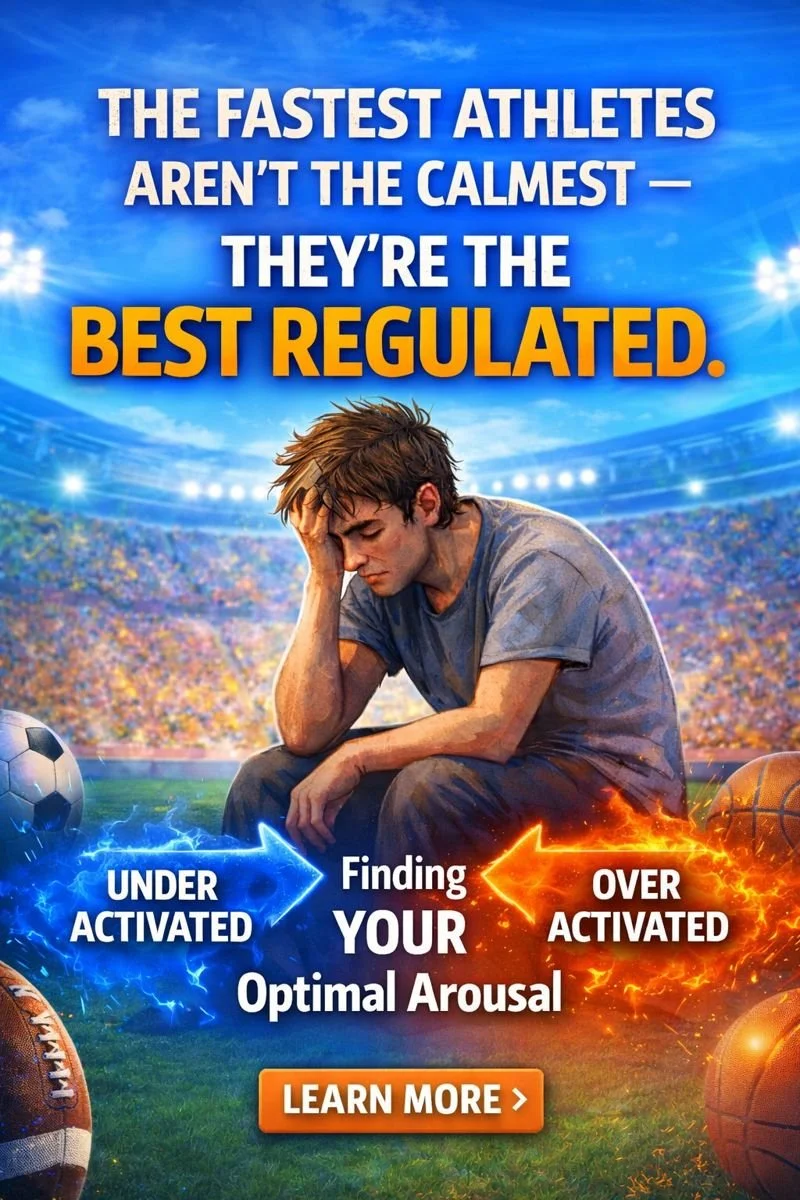
The Fastest Athletes Aren’t the Calmest — They’re the Best Regulated
For years, athletes have been told the same thing:
“Calm down.”
“Relax.”
“Just don’t overthink it.”
But here’s the truth most performance advice misses:
Peak performance doesn’t come from being calm.
It comes from being regulated.
And those two things are not the same.
Why “Calm” Is the Wrong Goal
If calm automatically led to performance, every elite athlete would look half-asleep before competition.
But they don’t.
Some athletes perform best fired up, intense, and highly energized.
Others need steadiness, rhythm, and controlled focus.
Some need to increase activation.
Others need to dial it down.
The difference between choking and excelling isn’t emotion —
it’s regulation.
Understanding Optimal Arousal Zones
Every nervous system has an optimal arousal zone — the state where reaction time, decision-making, coordination, and focus are at their best.
Too far below that zone?
Sluggish reactions
Low motivation
Disconnection
“I just can’t get going today”
Too far above that zone?
Muscle tension
Racing thoughts
Emotional reactivity
Mistakes you don’t usually make
Peak performance lives in the middle — but that middle is different for everyone.
Over-Activation vs. Under-Activation
Most athletes think the problem is “nerves.”
But in practice, I see two very different patterns:
Over-Activated Athletes
Feel anxious or panicky before performance
Rush plays or decisions
Tighten their body instead of trusting it
Try to “calm down” but end up suppressing energy instead
Under-Activated Athletes
Feel flat, disconnected, or unmotivated
Struggle to access intensity when it matters
Look calm on the outside but unfocused inside
Get told they “don’t want it enough”
Both struggle — for opposite reasons.
And neither is fixed by generic advice.
Regulation Is Individual — Not One-Size-Fits-All
Here’s the part most performance systems miss:
Your nervous system is not a flaw to override.
It’s a system to work with.
Real regulation means:
Knowing whether you need more or less activation
Recognizing early signs of dysregulation
Using tools that match your physiology — not someone else’s routine
Training regulation the same way you train strength or skill
When athletes learn this, performance stops feeling fragile.
Confidence becomes steadier.
Mistakes recover faster.
Pressure feels manageable instead of overwhelming.
Why This Matters Beyond Sports
Regulation doesn’t just affect performance.
It affects:
Confidence under pressure
Consistency
Burnout risk
Injury recovery
Motivation
Emotional resilience
Athletes who rely on willpower alone eventually hit a wall.
Athletes who learn regulation build careers that last.
Ready to Train Regulation — Not Just Push Through?
If you’ve ever thought:
“I know I’m capable of more, but my body won’t cooperate”
“I perform great in practice but not under pressure”
“I’m either too amped or not engaged enough”
That’s not a mindset problem.
It’s a regulation gap — and it’s trainable.
👉 [Work with me / Learn how individualized regulation training works]
👉 [Book a consult / Explore performance coaching options]
Because the goal isn’t calm.
The goal is regulated — on purpose, under pressure, when it counts.
