
“Mistake recovery is more important than mistake prevention.”
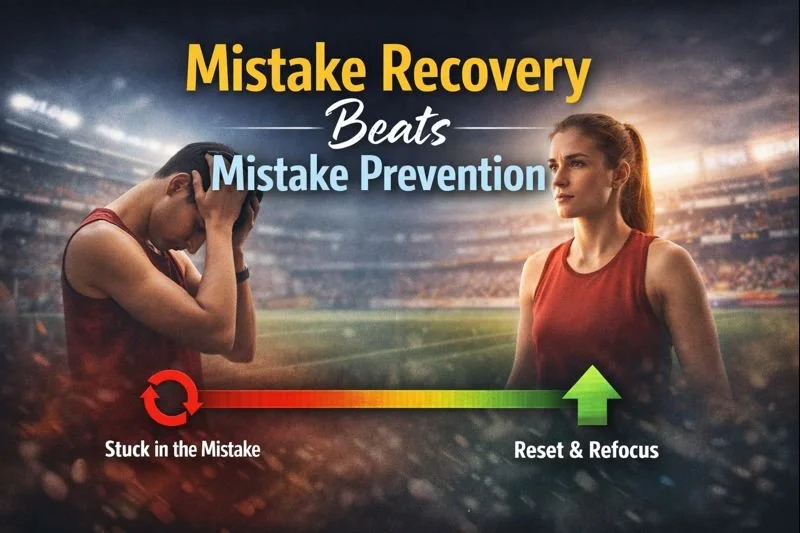
Recovery vs Prevention
“Mistake recovery is more important than mistake prevention.”
That’s not just a nice quote; it’s how high performers actually operate. In sport, in school, at work — the people who rise to the top are not the ones who never mess up. They’re the ones who can recover fast when they do.
One mistake, one spiral
You miss a shot.
You stumble over your words in a meeting.
You send the email with the wrong attachment.
The mistake itself is rarely the real problem. What hurts performance is what comes next:
Attention locks onto the error instead of the task.
Self‑talk turns harsh: “Seriously? You always do this.”
Your body tenses; heart rate climbs, breathing gets shallow.
Focus narrows to the mistake, so the next decision is rushed or hesitant.
This is how one error becomes a performance spiral: you’re now competing against your own reaction, not the situation in front of you.
Emotional reset: the invisible skill
Elite performers train their reset just as deliberately as their technique.
Emotional reset is the ability to notice “I’m spinning out” and bring your system back within seconds, not hours. It isn’t about pretending you don’t care. It’s about creating enough space to act on purpose again.
Simple reset tools include:
One slow exhale: In through the nose, out twice as long through the mouth.
A short phrase: “Next play,” “Reset,” or “This rep only.”
A physical cue: Touching your chest, tapping your leg, adjusting your stance.
The goal is not to erase the mistake. It’s to stop it from owning your next decision.
Attention control: where your brain looks, you go
After a mistake, your attention wants to cling to the replay: the miss, the fumble, the awkward moment. Attention control is the skill of directing your focus where it actually helps.
You can practice:
Narrowing focus: “What is the very next small action I control?”
External focus: Ball, breath, script, slide — something concrete outside your head.
Time focus: “This play, this slide, this question,” instead of the whole game or career.
When you control your attention, you cut off the spiral early. The mistake becomes one data point, not your new identity.
Why mistake recovery beats mistake prevention
Trying to prevent every mistake leads to:
Overthinking and hesitation.
Playing small to avoid risk.
Fragility: one slip and everything feels ruined.
Training mistake recovery leads to:
More courageous decisions (you know you can bounce back).
Consistency under pressure.
A realistic relationship with failure: it’s information, not a verdict.
High performers don’t trust perfection. They trust their reset.
CTA: Elite athletes reset faster
Watch the best in any sport: they miss, they grimace for half a second, then their body language changes. Shoulders drop. Eyes refocus. They’re already on the next play.
That’s not an accident. It’s trained.
If you want to perform closer to your potential — at work, in school, in your creative life — start treating mistake recovery as a core skill, not an afterthought. Practice your reset on small errors, every day, until it feels automatic.
Elite athletes aren’t mistake‑free. They just reset faster.
