
Emotional Intensity Is Part of ADHD — No One Teaches You How to Manage It
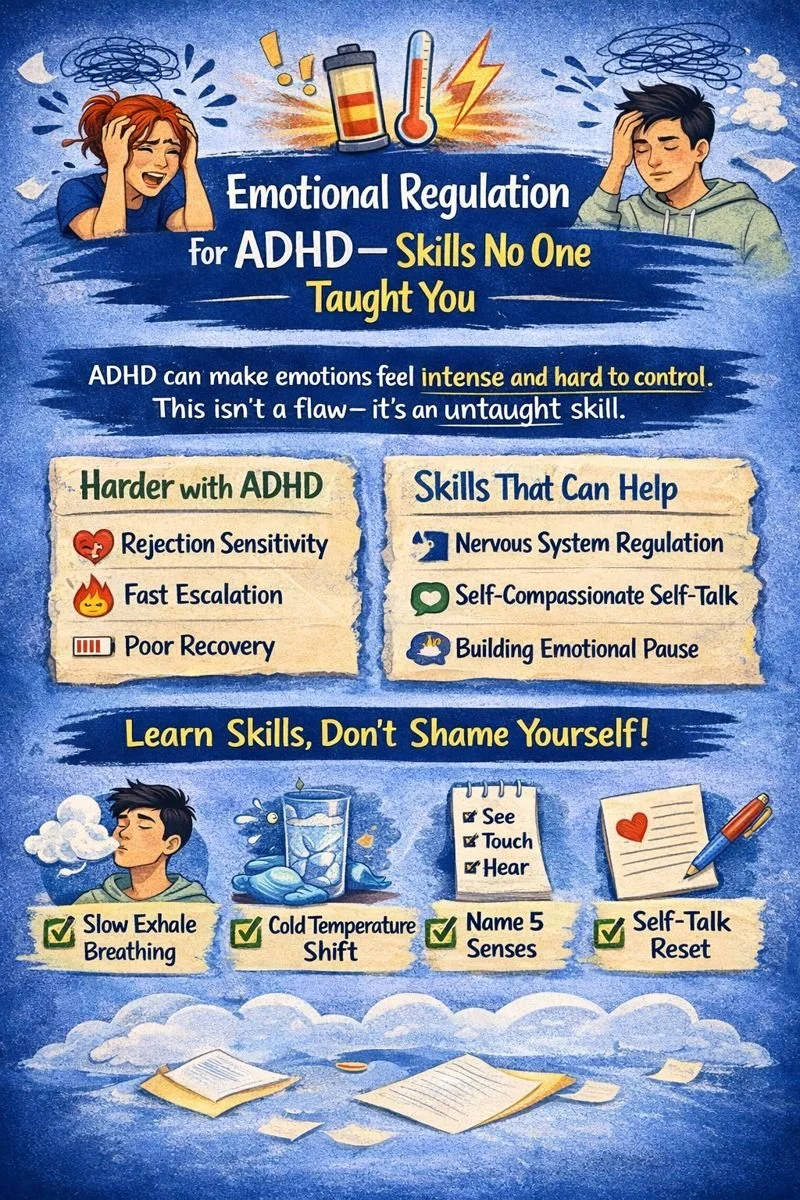
Skills no one Taught YOU!
“Emotional intensity is part of ADHD—no one teaches you how to manage it.”
If you live with ADHD, you’ve probably been told you’re too sensitive, too dramatic, or overreacting.
But what often looks like “overreacting” from the outside is actually a nervous system that reacts faster and stronger than average—and then struggles to calm back down.
This isn’t a character flaw.
It’s a skill gap.
And the good news? Skills can be learned.
Why Emotions Feel So Big With ADHD
ADHD is not just about attention. It also affects emotional regulation, which is the brain’s ability to:
Pause before reacting
Modulate emotional intensity
Return to baseline after stress
Research shows that many people with ADHD experience:
Stronger emotional reactions
Faster emotional escalation
Longer recovery times
This happens because the ADHD brain has differences in the prefrontal cortex (responsible for impulse control and regulation) and the limbic system (emotion center). When something feels threatening, disappointing, or critical, the emotional system can “fire” before the rational system has time to catch up.
Rejection Sensitivity: When Feedback Feels Like a Threat
Many people with ADHD experience what’s commonly called rejection sensitivity. While not a formal diagnosis, it describes a real pattern:
Strong emotional pain after perceived criticism
Fear of letting people down
Interpreting neutral feedback as rejection
Urges to withdraw, lash out, or shut down
Your nervous system is responding as if the relationship or your safety is at risk—even when your rational mind knows that’s not the case.
This is not weakness.
It’s a survival response that learned to stay on high alert.
Fast Emotional Escalation
For many with ADHD, emotions go from 0 to 100 very quickly.
You might notice:
Instant anger
Sudden tears
Panic over small setbacks
Feeling “flooded” before you can think
This is because emotional input travels faster than logical processing in the ADHD brain. The emotion arrives first. The explanation comes later.
That’s why people often say:
“I don’t mean to react that way—I just can’t stop it.”
And they’re telling the truth.
The Missing Piece: Nervous System Regulation
Most people with ADHD were never taught how to regulate their nervous system.
Instead, they were told to:
“Calm down”
“Stop overreacting”
“Just think positive”
But regulation doesn’t start with thoughts—it starts with the body.
When your nervous system is activated, your brain is not in learning or reasoning mode. It’s in protection mode. Until the body feels safer, logic won’t land.
Regulation Skills That Actually Help
These aren’t about suppressing emotions—they’re about helping your system settle:
Slow exhale breathing (longer out-breath than in-breath)
Temperature shifts (cold water on face, holding a cool object)
Movement (walking, stretching, shaking out tension)
Grounding (naming 5 things you can see, feel, or hear)
Self-talk that reduces threat, not shame
Over time, these skills teach your nervous system that strong feelings don’t equal danger.
You’re Not Broken—You’re Untrained
If you’ve spent your life being told you’re “too much,” it’s easy to believe something is wrong with you.
But emotional intensity in ADHD is not a defect.
It’s an untaught skill set.
Just like time management or organization, emotional regulation is something that can be learned with the right tools, practice, and support.
Final Reminder
These are skills, not personality flaws.
You are not too sensitive.
You are not failing at emotions.
You were simply never shown how to work with a nervous system that feels more deeply.
And you can learn!!!!!
