
When Sport Becomes Overwhelming: Neurodivergence, Masking, and Burnout in Competitive Athletes
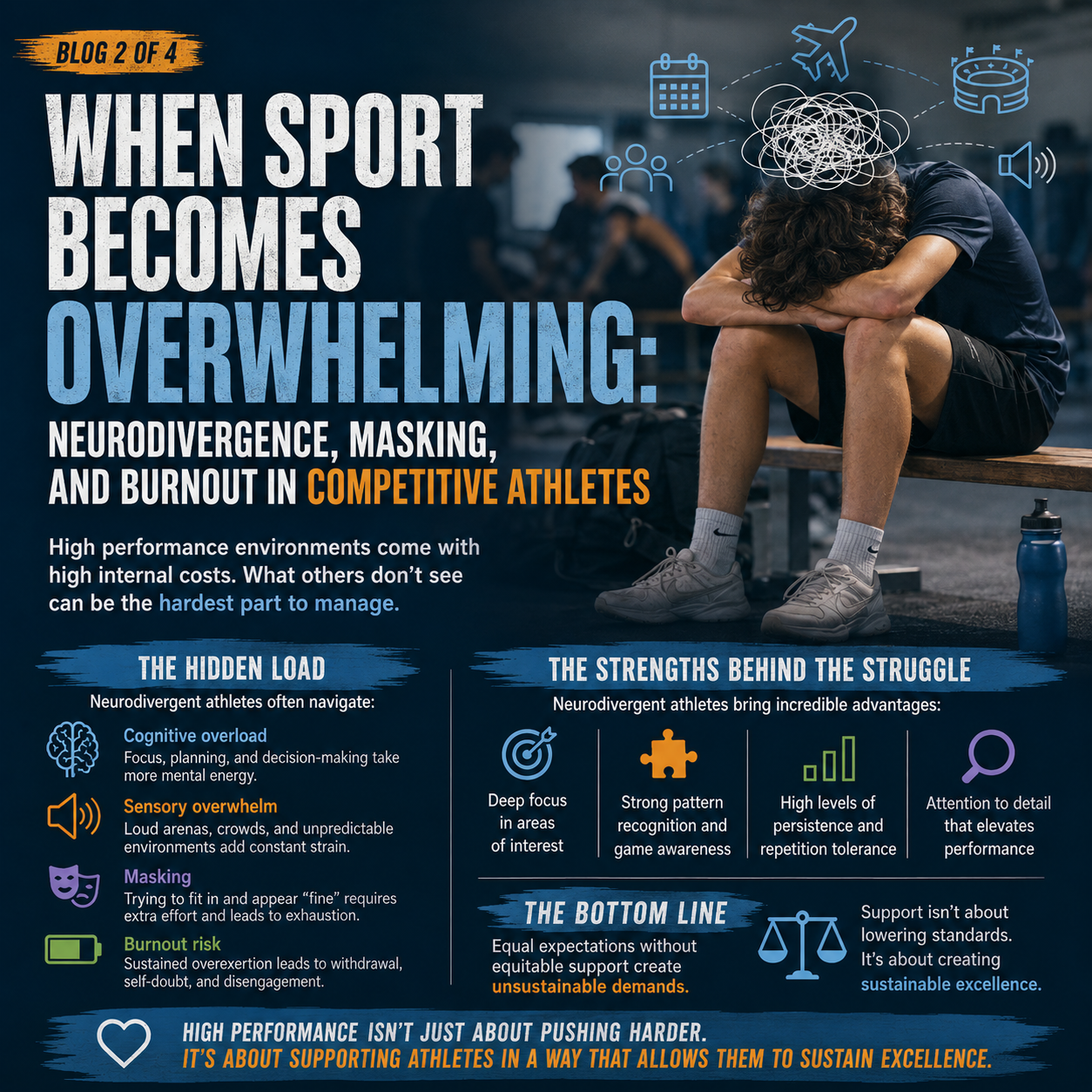
When Sport Becomes Overwhelming: Neurodivergence, Masking, and Burnout in Competitive Athletes
For many neurodivergent athletes competing at high levels, the hardest part of sport is not the competition.
It is everything surrounding it.
Travel schedules, multi-game tournaments, loud arenas, shifting expectations, and constant social interaction create a level of cognitive and sensory demand that is significantly higher than what most people see.
Athletes with ADHD, autism, OCD, and Tourette syndrome are often competing in the same high-performance environments as their peers—but with a very different internal load.
An athlete with ADHD may expend more mental energy sustaining focus across long competition days. An athlete with autism may be navigating sensory overwhelm while trying to execute complex plays. An athlete with OCD may be managing intrusive thoughts and perfectionism that intensify under pressure. Athletes with Tourette syndrome may experience increased symptoms with fatigue and stress.
These are not barriers to high performance.
But they do change how performance is accessed, sustained, and recovered from.
Many of these athletes develop exceptional strengths:
Deep focus in areas of interest
Strong pattern recognition and game awareness
High levels of persistence and repetition tolerance
Attention to detail that can elevate skill execution
These traits can become powerful performance assets.
However, they often come at a cost when environments are not aligned with the athlete's regulatory needs.
From a person-environment fit perspective, difficulties often arise not from the athlete themselves, but from a mismatch between environmental demands and the athlete's available cognitive, sensory, and emotional resources.
When cognitive load consistently exceeds an athlete's ability to regulate and recover, performance variability increases—and so does the risk of burnout.
Many athletes respond by masking.
They push through. They suppress distress. They try to match the outward behaviour of their teammates.
From the outside, they may appear composed.
But internally, they are working significantly harder to maintain that level of functioning.
Research increasingly suggests that sustained efforts to conceal differences or conform to expected expectations are associated with emotional exhaustion and poorer mental health outcomes.
Over time, repeated efforts to manage sensory input, social expectations, and performance demands can create cumulative stress.
Without sufficient recovery and support, this chronic strain may contribute to exhaustion, emotional dysregulation, and burnout.
Athletes may begin to withdraw, lose confidence, or disengage from a sport they are fully capable of succeeding in.
Not because they are not high-performance athletes.
But because equal expectations without equitable support create unsustainable demands.
Supporting these athletes is not about reducing challenge.
It is about ensuring that challenge remains within a range where performance, adaptation, and recovery can all occur.
For neurodivergent athletes, recovery involves more than physical rest.
Cognitive recovery, sensory decompression, predictable routines, and opportunities for emotional regulation may be equally important components of sustainable performance.
Because high performance is not just about pushing harder.
It is about supporting athletes in a way that allows them to sustain excellence.
In the next article, we will explore why fairness and equality are not always the same—and why equitable support can strengthen, rather than undermine, high-performance sport.
