
Fair Doesn’t Always Mean Equal: Rethinking Inclusion in Competitive Sport
Fair Doesn’t always mean Equal
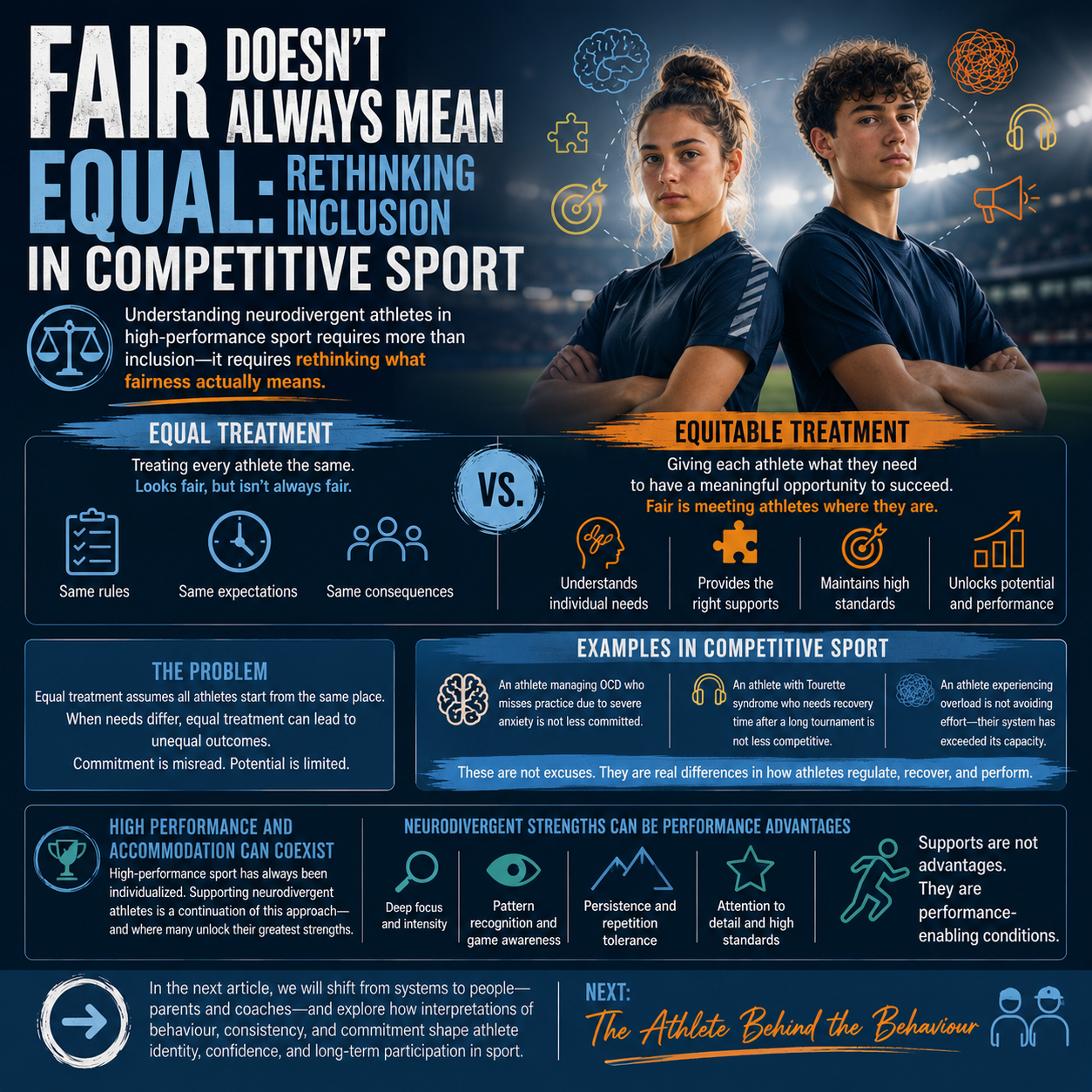
Understanding neurodivergent athletes in high-performance sport requires more than inclusion—it requires rethinking what fairness actually means.
In the previous article, we explored how neurodivergent athletes experience sport internally—how sensory load, cognitive demand, and masking can quietly shape performance and increase the risk of burnout.
But understanding the internal experience is only part of the picture.
What happens next depends heavily on how fairness is interpreted in the environments these athletes compete in.
And this is where many well-intentioned systems begin to break down.
In competitive sport, fairness is often defined as treating every athlete the same.
At the high-performance level, this can look like consistent attendance expectations, equal consequences, and standardized roles.
But equal treatment is not always equitable treatment.
And this distinction becomes critical when working with neurodivergent athletes in sport.
Athletes competing on rep and elite teams may occasionally need to miss practice, arrive late, take breaks, or manage fluctuations in symptoms related to ADHD, autism, OCD, Tourette syndrome, anxiety, or sensory overload.
When these differences are interpreted as lack of commitment, athletes may be penalized through reduced playing time or lost opportunities.
While these decisions are often made with good intentions, they can unintentionally exclude athletes who are otherwise capable of performing at a high level.
Fairness is not about giving every athlete the same.
It is about giving each athlete what they need to have a meaningful opportunity to succeed.
An athlete managing OCD who misses a practice due to severe anxiety is not less committed. An athlete with Tourette syndrome who needs recovery time after a long tournament is not less competitive. An athlete experiencing overload is not avoiding effort—their system has exceeded its regulatory capacity.
High Performance and Accommodation Can Coexist
There is a persistent belief that accommodations undermine competitive standards.
In reality, high-performance sport has always been individualized.
Training is adapted. Recovery is tailored. Roles are specialized.
Supporting neurodivergent athletes is a continuation of this approach.
It is also where many athletes unlock their greatest strengths.
The same traits associated with neurodivergence—focus, intensity, pattern recognition, persistence—can become performance advantages when environments are structured appropriately.
These supports are not advantages.
They are performance-enabling conditions.
Equal treatment assumes all athletes start from the same place.
Equitable treatment recognizes that they do not—and adjusts the environment accordingly so that high standards remain achievable.
Inclusion at the competitive level is not about lowering expectations.
It is about removing barriers so that athletes can meet—and often exceed—them.
In the next article, we will shift from systems to people—parents and coaches—and explore how interpretations of behaviour, consistency, and commitment shape athlete identity, confidence, and long-term participation in sport.
👉 Next: The Athlete Behind the Behaviour
