
Neurodivergent Athletes in Competitive Sport: What We’re Missing
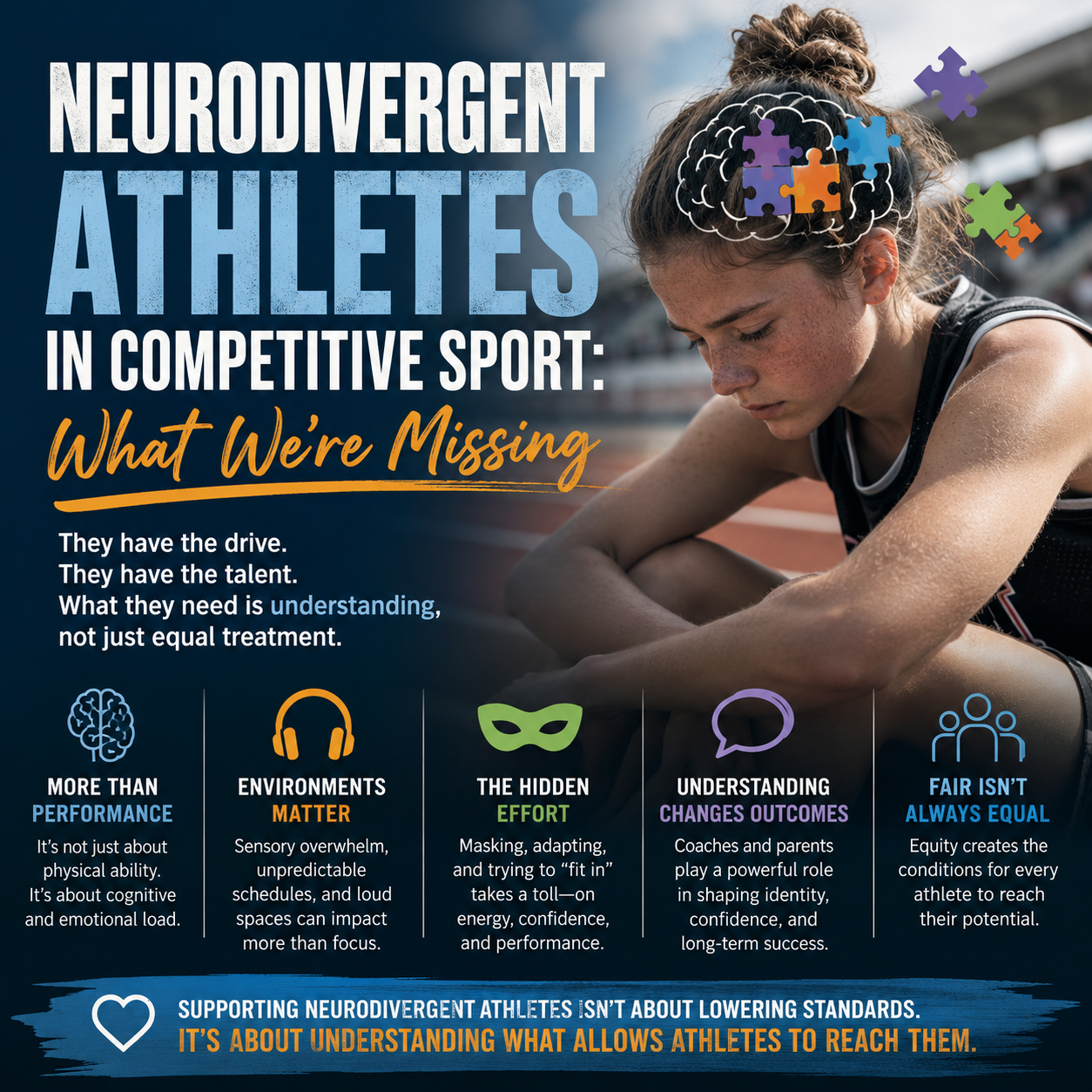
There is a growing conversation around inclusion in sport. But for many neurodivergent athletes competing at high levels—rep teams, travel teams, and elite pathways—something still feels off.
On paper, opportunities exist. Teams are competitive. Standards are high. Expectations are clear.
And yet, many athletes with ADHD, autism, OCD, Tourette syndrome, and anxiety quietly struggle—not because they lack ability, but because the environments they are in were not designed with their needs in mind.
In high-performance sport, we talk about marginal gains, mental toughness, and optimizing performance under pressure.
What we talk about far less is cognitive load, sensory overwhelm, masking, and the mental energy required just to stay regulated in demanding environments.
For some athletes, showing up to a tournament is not just about competing.
It is about managing:
Noise, travel, and unpredictable schedules
Social expectations and team dynamics
Internal pressure, perfectionism, and emotional regulation
The effort required to appear unaffected
These demands are often invisible—but they directly impact performance consistency, recovery, and confidence.
At the same time, many coaches and organizations are trying to be fair by treating athletes equally.
But equal treatment is not always equitable treatment.
And in high-performance environments, that distinction matters.
Because fairness is not about giving every athlete the same conditions.
It is about creating conditions where every athlete has a genuine opportunity to perform at their best.
It is also important to recognize that many of the traits associated with neurodivergence—intense focus, pattern recognition, persistence, creativity, and high attention to detail—can become powerful performance assets when properly supported.
In other words, these differences are not just challenges.
They can be strengths.
This is not just an inclusion issue. It is a performance issue.
And when environments fail to adapt, talented athletes are not just overlooked—they are lost from sport entirely.
In this series, we will explore:
Why high-performance sport can become overwhelming for neurodivergent athletes
Why equal does not always mean equitable in competitive environments
How coaches and parents influence confidence, identity, and long-term outcomes
Because supporting neurodivergent athletes is not about lowering standards.
It is about understanding what allows them to reach—and often exceed—them.
If your child is struggling with confidence, overwhelm, or burnout in sport, support is available. In-Person in Office & Virtual sessions are available across Ontario
