
ADHD Task Switching: Why Starting and Changing Tasks Feels So Hard
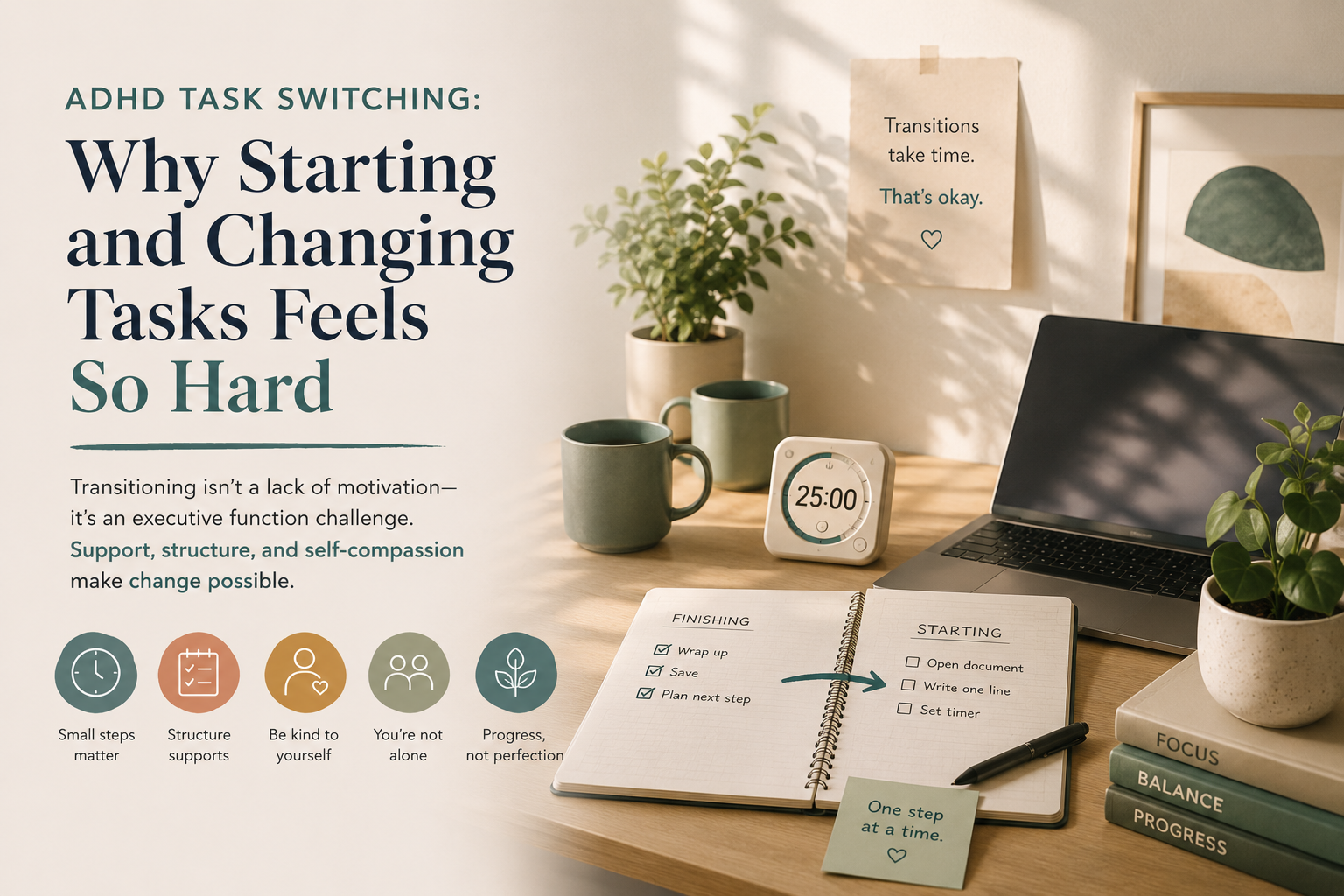
ADHD Task Switching: Why Starting and Changing Tasks Feels So Hard
Many people think ADHD is mainly a problem with attention. In reality, one of the biggest challenges is often task switching — starting a task, stopping a task, or moving from one activity to another.
This is why someone with ADHD may stay stuck for hours unable to begin something important, or may hyperfocus on a low-priority task while avoiding what actually needs to get done.
From a clinical perspective, the issue is often not “lack of focus.” It is difficulty regulating attention, motivation, and transition between tasks.
Why Task Switching Is So Hard
Task switching involves several skills that are often affected in ADHD:
Shifting attention from one task to another.
Stopping one activity without feeling abruptly cut off.
Initiating a new task, especially if it feels boring, overwhelming, or high-pressure.
Filtering competing thoughts, distractions, and priorities.
Research on ADHD and executive functioning shows that difficulties with shifting, inhibition, and working memory are common. That means the challenge is often less about attention itself and more about the brain’s ability to move between tasks efficiently.
What It Can Look Like in Daily Life
Task switching difficulty can show up in ways that many people misread as laziness, avoidance, or lack of motivation.
Common examples include:
Taking a long time to start a task, even when it matters.
Getting stuck on one activity and losing track of time.
Feeling frustrated or overwhelmed when interrupted.
Moving slowly between work, home, caregiving, or school tasks.
Knowing what to do, but still feeling unable to begin.
For many clients, the hardest part is not the task itself — it is the transition into the task.
What Helps With Task Switching
Support strategies work best when they reduce pressure and make transitions easier.
Helpful approaches include:
Using timers or alarms to signal transitions.
Breaking tasks into very small steps.
Creating a start ritual, such as opening the laptop, writing a first sentence, or tidying the workspace.
Grouping similar tasks together to reduce mental switching.
Building in buffer time between activities.
Using visual schedules or written checklists.
Trying body doubling, where another person is present while the task is started or completed.
These strategies do not “fix” ADHD, but they can make switching feel more manageable and less overwhelming.
The Emotional Side of Switching
Task switching struggles are not only practical. They can also bring up shame, anxiety, and self-criticism.
Clients may begin to believe things like:
“I’m lazy.”
“I never follow through.”
“Everyone else can do this except me.”
Over time, these experiences can affect self-esteem and create a cycle of avoidance. A trauma-informed approach is important because shame often makes task switching even harder.
What Social Workers Should Notice
In clinical work, it helps to shift the question from:
“Why can’t you focus?”
to
“What makes transitions difficult right now?”
That small change opens the door to more supportive, collaborative care. It also helps clients feel understood rather than judged.
For social workers, this means:
Normalizing task switching difficulties.
Helping clients identify their transition triggers.
Supporting nervous system regulation before task changes.
Collaborating on realistic routines instead of perfectionistic expectations.
When to Reach Out for Support
If ADHD-related task switching is affecting work, school, relationships, or daily routines, extra support can help. Therapy can be a place to explore the emotional impact of these struggles and build practical strategies that fit the client’s brain and life.
A social work approach can also help reduce shame, strengthen self-understanding, and support more sustainable routines.
Final Thought
Clients are often not struggling with what to do. They are struggling with how to move between doing it.
That difference matters. And for many people with ADHD, it is where real change begins.
