
When “Development” Doesn’t Develop: How Organizations Let Athletes Down
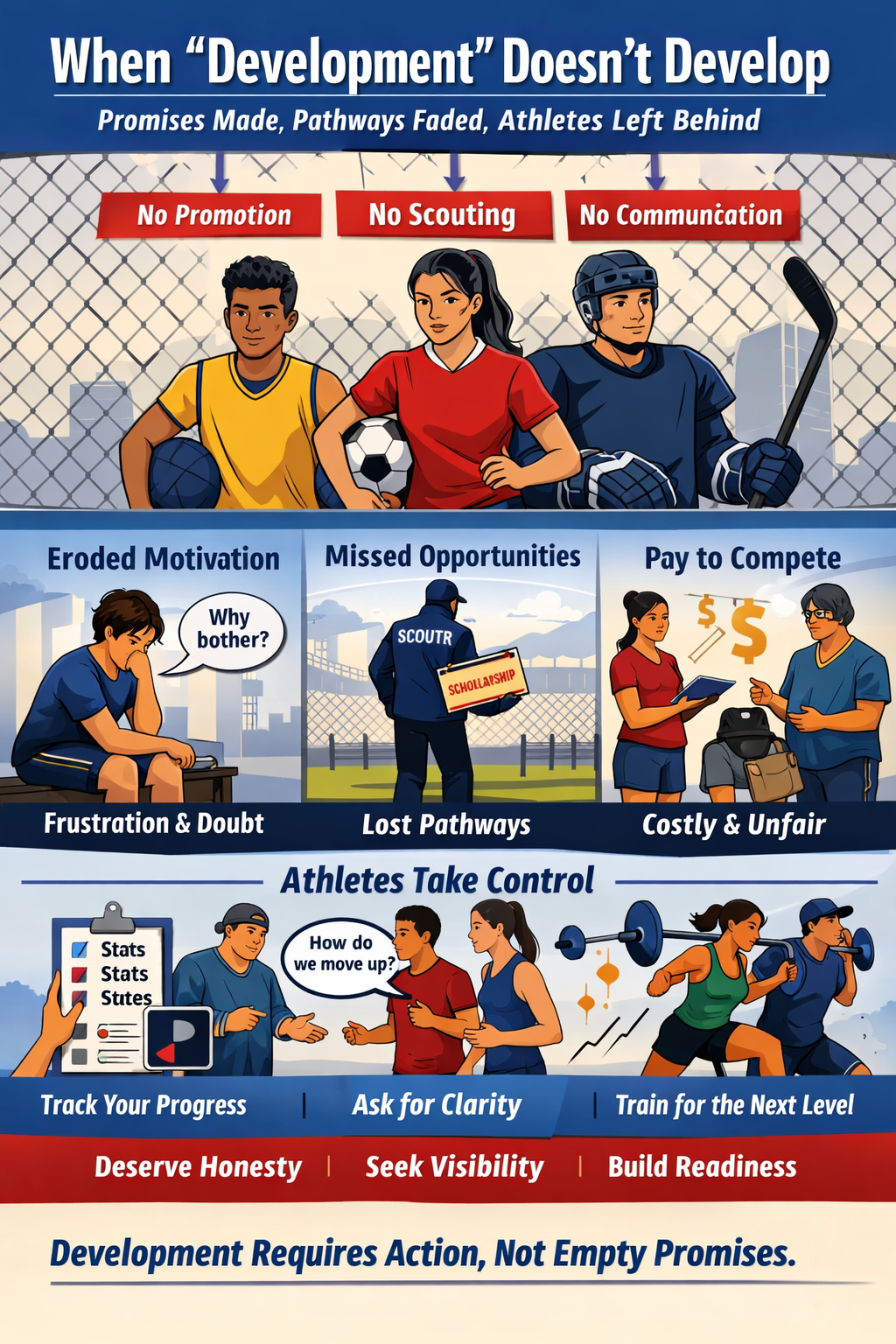
Youth sport systems often use one powerful word in their branding:
Development.
It’s on websites.
It’s in mission statements.
It’s in parent meetings.
But development is not a marketing term.
It is a responsibility.
And when organizations fail to actively scout, evaluate, communicate pathways, or advance athletes who have earned progression, the consequences extend far beyond hurt feelings.
They affect futures.
The Psychological Cost of Organizational Inaction
Athletes can handle losing.
They can handle difficult feedback.
They can handle high standards.
What they struggle with is silence.
Inconsistency.
And invisible pathways.
When athletes increase effort, improve skill, and deepen commitment — yet remain stagnant within a system — motivation begins to erode.
According to Self-Determination Theory (Edward Deci; Richard Ryan), athletes need:
Competence
Autonomy
Relatedness
When no one is tracking their development, when no transparent criteria exist, when technical leadership is not actively observing growth — those needs are undermined.
This is not an athlete flaw.
It is a structural failure.
When Opportunity Impacts Scholarships and Semi-Professional Pathways
For athletes aiming to:
Play semi-professionally
Earn collegiate scholarships
Enter high-performance training environments
Visibility matters.
Exposure matters.
Movement between levels matters.
When a club markets itself as developmental but does not:
Actively promote players to scouts
Facilitate showcase exposure
Provide documented performance evaluations
Create upward mobility within the organization
It can directly limit an athlete’s recruitment potential.
Recruiters and scouts often assess:
Level of competition
Quality of training environment
Leadership endorsement
Performance under higher-level pressure
If athletes are not placed into those environments, their development becomes harder to verify externally.
This creates inequity.
Some athletes then rely on:
Private connections
Outside trainers
Who they know
Independent showcases
Additional paid exposure opportunities
All while families continue paying club fees under the assumption that “development” includes advancement and visibility.
When advancement depends more on networking than performance metrics, trust erodes.
And trust is foundational in youth sport systems.
The Psychological Fallout
When athletes believe:
Effort does not lead to opportunity
Advancement depends on politics
Progress is disconnected from performance
They may internalize doubt or disengage.
Research by Martin Seligman on learned helplessness demonstrates that repeated experiences of effort without outcome change can reduce persistence and belief.
In sport, this looks like:
Reduced intensity
Playing cautiously
Emotional withdrawal
Quiet consideration of quitting
The tragedy is this:
Many of these athletes are not underperforming.
They are under-exposed.
Hard Truth: Marketing Development Without Delivering It Is Harmful
If an organization charges premium fees under the banner of development, then development must include:
Transparent criteria for movement
Active scouting within the club
Communication with athletes about realistic pathways
Honest conversations about scholarship probability
Objective performance tracking
Otherwise, the burden shifts to families to self-navigate recruitment — while still funding the system.
That is not development.
That is outsourcing responsibility.
For Athletes: Psychological Enhancements When Systems Fall Short
While organizations must be accountable, athletes still need tools.
1. Build Your Own Performance Portfolio
Track:
Game statistics
Training metrics
Video highlights
Strength and conditioning benchmarks
Document your growth. Do not rely solely on club validation.
2. Seek Direct Clarity
Ask:
What specifically moves a player to the next level?
Who is responsible for scouting within the club?
How are athletes promoted to recruiters?
Clear questions create pressure for clear systems.
3. Prepare for the Level You Want — Not the One You’re In
Train mentally and physically for the semi-pro or collegiate environment now:
Higher pace decision-making drills
Mental rehearsal under pressure
Independent film study
Strength standards aligned with the next level
Readiness protects confidence when systems lag.
A Message to Leadership
Youth athletes are not just roster spots.
They are investing years of work, family resources, and future aspirations into your program.
If development is part of your identity, it must be measurable.
If advancement is possible, it must be visible.
If scholarships and semi-professional pathways are implied, they must be actively supported — not left to chance or private connections.
Because when leadership systems fail, athletes begin to question themselves.
And here is the hard truth:
If your environment becomes the reason an athlete wants to quit the sport they once loved, something is broken.
And it may not be the athlete.
Leaders in youth sport carry influence that extends far beyond wins and losses. You shape confidence. You shape identity. You shape belief.
If your system repeatedly overlooks effort, blocks pathways, or markets development without delivering it, then accountability is required.
And sometimes accountability means asking:
Have we outgrown our ability to lead this level of athlete development?
If so, it may be time to evolve the system — or step aside for leadership that will.
Because no athlete should leave a sport due to organizational neglect.
They should leave because they chose a different dream — not because someone failed to protect the one they had.
