
ADHD and Executive Dysfunction: Why Starting Tasks Feels Impossible
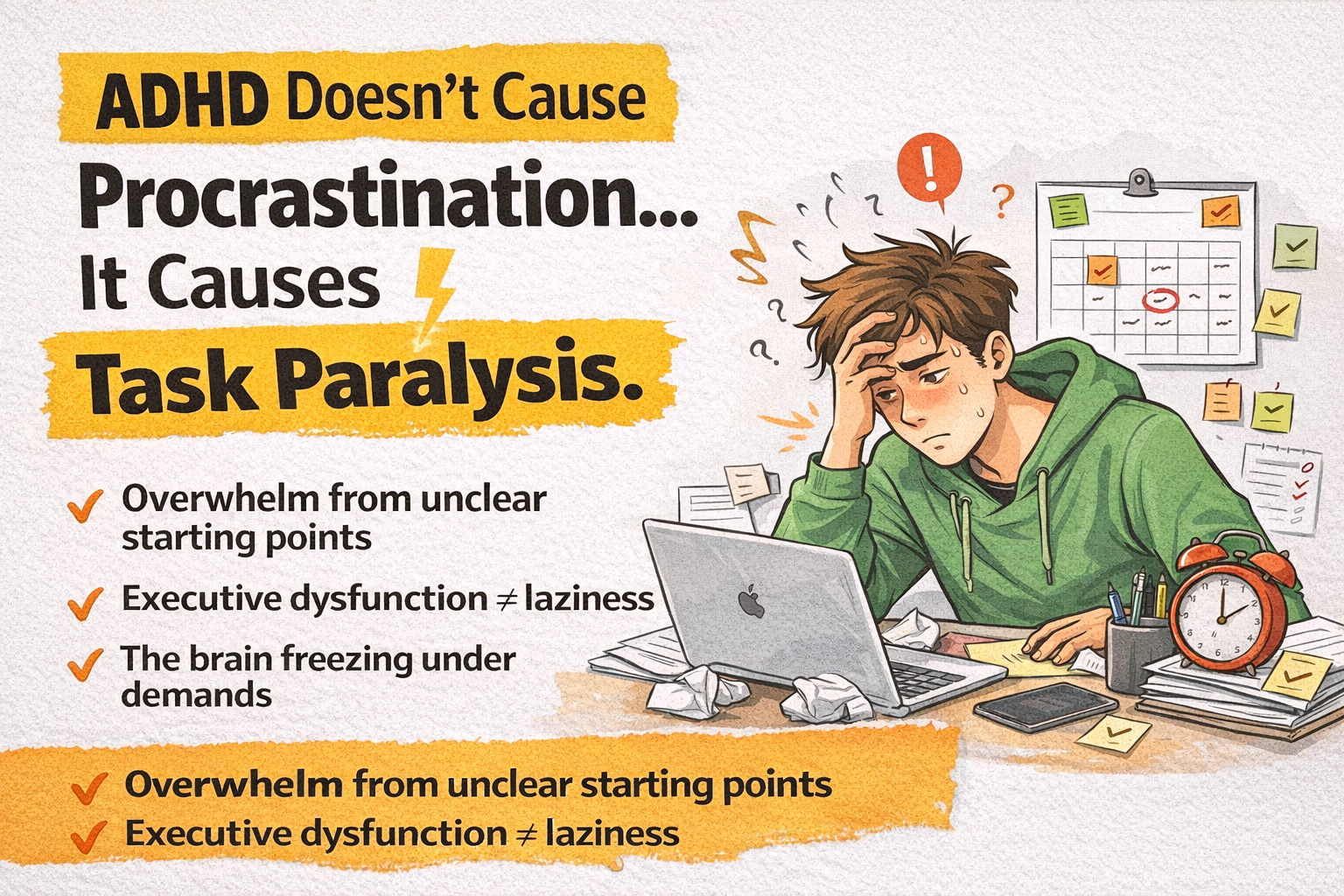
ADHD and Task Paralysis: Why It’s Not Just Procrastination
You open the laptop.
You look at the task.
You know exactly what needs to be done.
And yet… you still can’t start.
Minutes pass.
Then 45 minutes.
Nothing happens.
If you live with ADHD, this experience is extremely common.
Many people assume this is procrastination. But for many individuals with ADHD, the problem is something different:
Task paralysis.
Understanding the difference matters — because it changes how we respond.
What Looks Like Procrastination Is Often Executive Dysfunction
When most people think of procrastination, they imagine avoidance.
But when clinicians assess ADHD, they look at executive functioning.
Executive functions are the brain’s management system. They help us:
• initiate tasks
• plan and organize
• hold information in working memory
• regulate emotions
• shift attention when needed
Research consistently shows that ADHD is associated with impairments in executive functioning, particularly task initiation and activation (Russell Barkley, 2015; Thomas E. Brown, 2013).
This means the issue often isn’t motivation.
The brain struggles to generate the activation energy required to begin.
And when activation fails, the result can feel like paralysis.
Why Unclear Starting Points Trigger Shutdown
One of the most common triggers of ADHD task paralysis is ambiguity.
When a task lacks:
• a clear first step
• a visible endpoint
• immediate feedback
• emotional urgency
…the ADHD brain can stall.
The prefrontal cortex — responsible for planning and organizing — already works differently in individuals with ADHD. When the starting point is unclear, cognitive load increases.
When cognitive load rises too high, the nervous system can freeze.
This isn’t laziness.
It’s overload.
Emotional Load Can Also Block Activation
Task paralysis is not only cognitive.
Many tasks carry emotional weight.
Perfectionism, fear of failure, rejection sensitivity, or past experiences of criticism can increase the emotional pressure attached to a task.
When emotional threat combines with executive dysfunction, the brain may avoid the task entirely.
Not because the person doesn’t care.
But because starting feels overwhelming.
Time Blindness and the Urgency Problem
Another well-documented aspect of ADHD involves difficulty perceiving time.
Research from Russell Barkley describes ADHD as involving impairments in temporal processing, often referred to as time blindness.
Deadlines that are far away may not trigger motivation.
But when urgency becomes immediate?
Activation suddenly appears.
This is why many individuals with ADHD can:
• perform extremely well under pressure
• hyperfocus when urgency appears
• respond quickly during crises
But struggle with everyday tasks that feel distant or unstructured.
This isn’t inconsistency.
It’s neurobiology.
The Brain Freezing Under Demand
Functional imaging studies show differences in dopamine regulation and activation pathways in ADHD brains.
Dopamine plays an important role in:
• motivation
• effort allocation
• reward anticipation
When tasks feel:
• large
• boring
• unstructured
• emotionally neutral
…the brain may not produce enough dopamine to trigger engagement.
The result isn’t intentional delay.
It’s neurological stalling.
Why Shame Makes It Worse
Repeated experiences of task paralysis often lead to:
• self-criticism
• fear of starting
• avoidance cycles
• learned helplessness
Over time the internal narrative becomes:
“I’m broken.”
“I’m unreliable.”
“I can’t trust myself.”
This emotional layer intensifies executive dysfunction and makes starting even harder.
The Intervention Many People Miss: Shrinking the Entry Point
If ADHD paralysis is largely about activation energy, the solution is not simply “try harder.”
Instead, the goal is to lower the entry barrier.
Strategies often used in ADHD coaching and cognitive behavioural approaches include:
• breaking tasks into extremely small steps
• externalizing planning onto paper
• using body-doubling
• creating artificial urgency with timers
• making the first action visible and specific
Instead of:
Clean the kitchen.
Try:
Pick up three items.
Instead of:
Write the report.
Try:
Open the document.
Small entry points reduce cognitive load and make activation easier.
And once the brain starts…
momentum often follows.
Reframing the Narrative
If you work with adolescents or adults with ADHD, consider this shift:
From
“They’re procrastinating.”
To
“They’re stuck at the activation stage.”
From
“They’re avoidant.”
To
“The starting point isn’t neurologically accessible yet.”
Reducing shame often increases strategy.
The Bottom Line
ADHD does not simply cause procrastination.
For many individuals, it creates task paralysis driven by executive dysfunction, emotional load, and difficulty with activation.
Small starting points can make a powerful difference.
Because once the brain starts…
…it often keeps going.
