
Why ADHD in Adults Doesn’t Look the Way You Expect
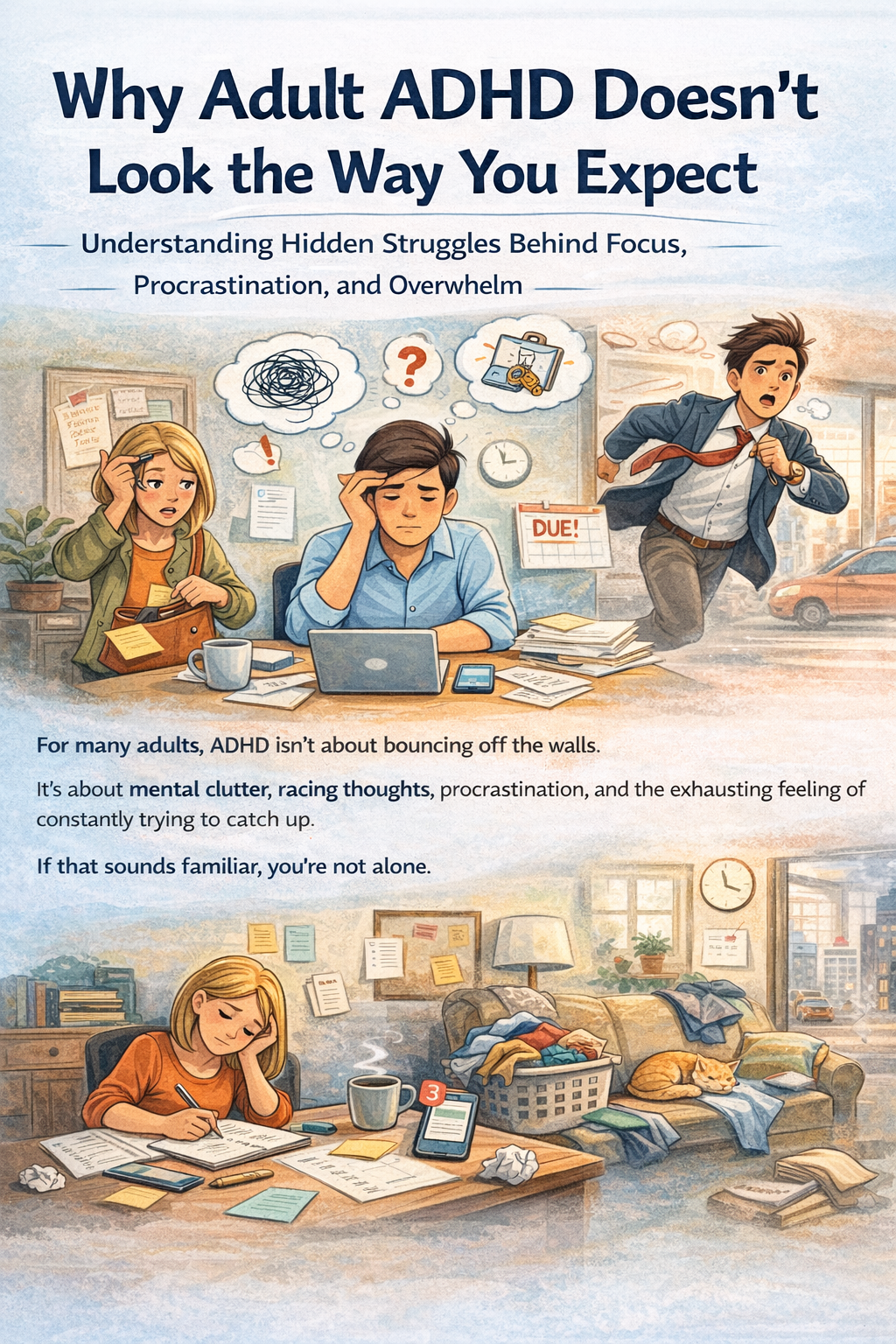
Understanding the Hidden Struggles Behind Focus, Procrastination, and Overwhelm
Many people still picture ADHD as a child who can’t sit still in class.
But adult ADHD often looks very different.
Instead of obvious hyperactivity, it can show up as:
The professional who is brilliant in meetings but constantly misses deadlines
The university student who understands the material but can’t start assignments until the night before
The person who forgets birthdays, loses track of time, or struggles to answer emails
The high-achiever who secretly feels overwhelmed by “simple” tasks
For many adults, ADHD isn’t about bouncing off the walls.
It’s about mental clutter, racing thoughts, procrastination, and the exhausting feeling of constantly trying to catch up.
If that sounds familiar, you’re not alone.
The ADHD Map: Why Things Break Down
Many adults with ADHD describe a frustrating pattern with work or school tasks.
At first, everything seems manageable.
Then something shifts.
Look at the ADHD map below. It shows the common places where things begin to break down.
1. Executive Function Challenges
ADHD affects a group of brain skills called executive functions.
These include:
Focus – filtering distractions
Working memory – holding information in mind
Organization – planning and sequencing tasks
Task initiation – starting work
Time awareness – understanding how long things take
When these systems struggle, tasks that seem simple to others can suddenly feel confusing or overwhelming.
Many adults experience:
Time blindness – underestimating how long something will take
Task paralysis – not knowing where to start
Procrastination – delaying until pressure builds
It’s not laziness.
It’s a difference in how the brain regulates attention and activation.
2. Where Assignments (or Tasks) Break Down
For many students and professionals, the process looks like this:
Task assigned → Plan to do it later → Hard to start → Overwhelm → Last-minute rush
This is often called the ADHD activation gap.
Your brain may fully understand the importance of the task, but the internal “start engine” doesn’t engage until urgency appears.
That’s why many people with ADHD suddenly become extremely productive right before a deadline.
Urgency activates the brain.
But relying on urgency can also lead to:
stress
burnout
missed deadlines
self-criticism
Over time, this creates a painful internal question:
“Why can’t I just get it together?”
3. The Energy Cliff
Many adults with ADHD describe their motivation like standing in a valley.
On one side is “Hard to Start.”
On the other side is “Last Minute Panic.”
The middle space, where steady progress happens, often feels difficult to access.
This isn’t about willpower.
ADHD brains are more strongly motivated by:
interest
novelty
challenge
urgency
When tasks don’t activate those systems, getting started can feel almost physically difficult.
ADHD Is Not Just About Focus
One of the most misunderstood aspects of adult ADHD is emotional regulation.
Many adults experience:
intense frustration
rejection sensitivity
feeling deeply discouraged by small setbacks
overwhelm when tasks pile up
Because ADHD is often invisible, many people grow up believing they are:
lazy
careless
disorganized
“too much”
In reality, they’ve been navigating a brain that works differently without the right support or explanation.
This is especially common in women, high-achieving students, and professionals whose intelligence helped them compensate for years.
The Strengths Side of ADHD
While ADHD brings challenges, it often comes with powerful strengths as well.
Many adults with ADHD are:
creative thinkers
strong problem-solvers
highly empathetic
energetic and passionate
able to hyperfocus deeply on things that interest them
excellent big-picture thinkers
When people finally understand how their brain works, they often stop asking:
“Why can’t I be like everyone else?”
And start asking:
“How can I build systems that work for my brain?”
What Actually Helps Adults With ADHD
The goal isn’t forcing yourself into systems that don’t fit.
It’s finding strategies that support how your brain naturally operates.
Some helpful supports include:
Practical Systems
breaking tasks into very small steps
using visual planners or reminders
creating structured work sprints
reducing decision fatigue
Environmental Supports
quiet workspaces
body-doubling or study partners
external accountability
Professional Support
ADHD-informed therapy
coaching
medication when appropriate
When these supports are in place, many adults experience enormous relief.
Things that once felt impossible start to become manageable.
The Most Important Shift: Understanding Your Brain
For many adults, the biggest change happens when they finally realize:
ADHD is not a character flaw.
It is a neurodevelopmental difference in how the brain regulates attention, motivation, and executive functioning.
With the right support, adults with ADHD can thrive academically, professionally, and personally.
Often the journey begins with one simple step:
Understanding your patterns instead of blaming yourself for them.
If This Sounds Familiar
If you recognize yourself in these patterns, you’re not alone.
Many adults spend years feeling frustrated or ashamed before realizing ADHD may be part of the picture.
Support can help you:
understand your attention patterns
reduce overwhelm and procrastination
build systems that actually work
reconnect with your strengths
Because thriving with ADHD isn’t about trying harder.
It’s about learning how to work with your brain instead of against it.
