
Lying is often seen as a character flaw. But in ADHD, it can be a stress response
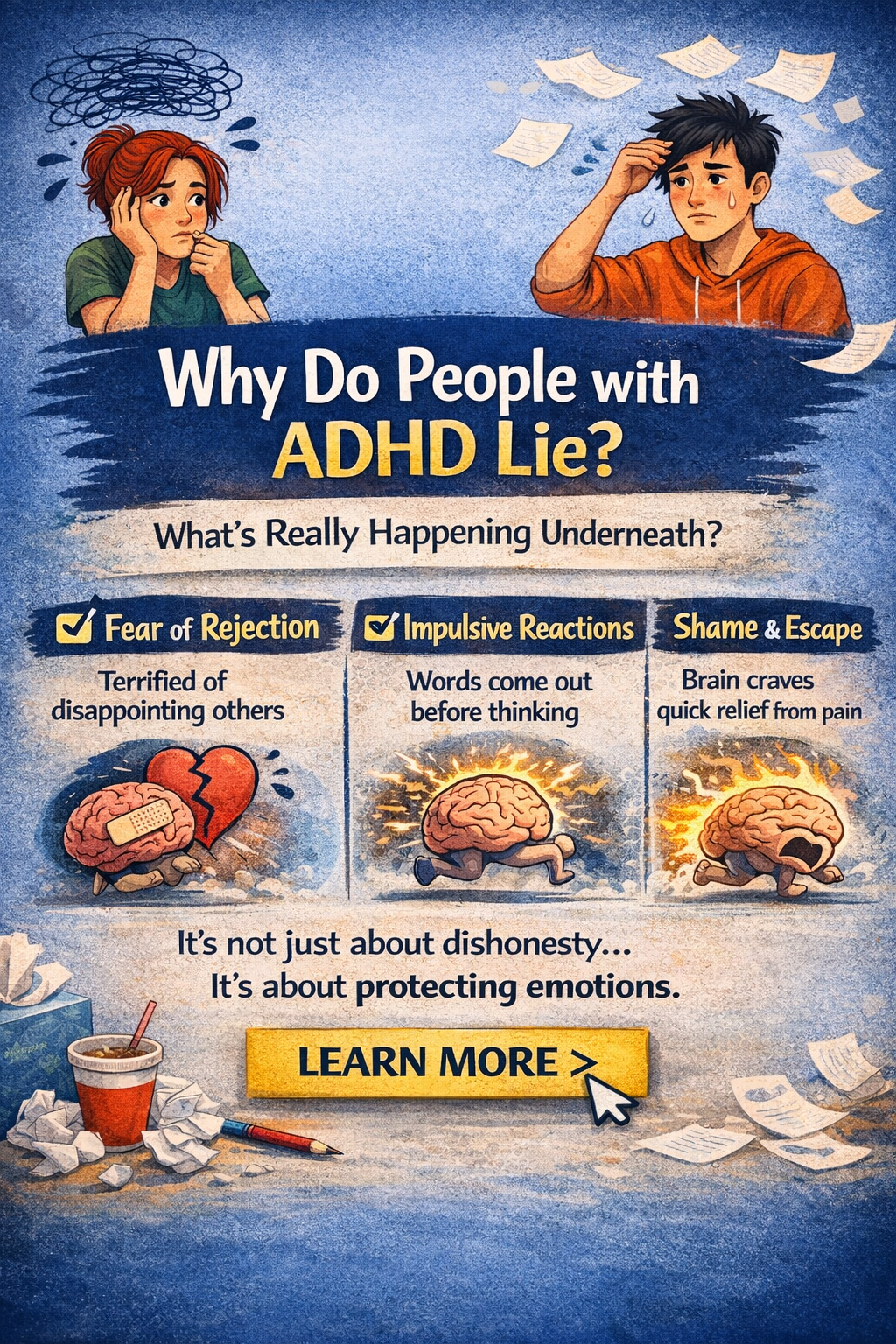
Why Do Some People with ADHD Lie?
When people hear the word lying, they often assume intentional deception or manipulation.
But in ADHD, the reasons are often neurological, emotional, and protective — not moral.
For many individuals, lying is not planned. It happens quickly, under pressure, when the nervous system is trying to reduce distress.
One of the most important factors behind this is rejection sensitivity.
The Role of Rejection Sensitivity (RSD)
Many people with ADHD experience intense emotional pain when they believe they have disappointed someone, made a mistake, or are being judged. This pattern is often called rejection sensitive dysphoria (RSD).
When rejection sensitivity is triggered, the brain can interpret even small problems as serious social threats — such as losing approval, being shamed, or damaging a relationship.
That emotional pain can feel immediate and overwhelming.
In those moments, honesty may feel unsafe — not logically, but emotionally.
The nervous system shifts into protection mode, and the fastest way to reduce the distress may be avoidance.
Sometimes that avoidance looks like:
denying what happened
minimizing the mistake
changing the story
hiding information
saying what feels safer in the moment
From the outside, this looks like dishonesty.
From the inside, it often feels like emotional self-protection.
When emotional reactions are fast and intense, behaviour can follow just as quickly — before reflection, problem-solving, or regulation has time to occur.
In this context, lying is often not about controlling others — it is about escaping overwhelming feelings.
But Rejection Sensitivity Is Not the Only Reason
Not all lying in ADHD is driven by rejection sensitivity. Several other ADHD-related challenges can also contribute.
Understanding these helps reduce blame and increase effective support.
1. Impulsivity — Speaking Before Thinking
ADHD affects response inhibition. This means words may come out before the person has time to reflect, check accuracy, or consider consequences.
Someone might:
answer quickly without thinking
guess instead of admitting uncertainty
say something untrue and only realize later
This is not planned deception — it is reduced pause time between feeling and speaking.
2. Working Memory Difficulties — Inconsistent Recall
Working memory helps us hold and organize information in the moment. When it is weak, details can be lost, mixed up, or remembered differently.
A person may genuinely believe something happened one way, then later recall new details and appear inconsistent.
From the outside this can look like lying.
Internally, it may feel like confusion or fragmented recall.
3. Difficulty Holding Future Consequences in Mind
Many people with ADHD struggle to keep future outcomes emotionally “real” in the present moment — especially when they are stressed or overwhelmed.
When distress is high, the brain prioritizes immediate relief over long-term outcomes.
This can lead to statements like:
“I already did it”
“I was just about to start”
“It’s not a big deal”
In that moment, the goal is to reduce pressure right now — not to evaluate what might happen later.
This is not a lack of caring about consequences.
It is difficulty keeping them mentally present while emotionally flooded.
4. Chronic Shame and Learned Self-Protection
Many individuals with ADHD grow up receiving frequent correction, criticism, or messages that they are “too much,” “careless,” or “not trying hard enough.”
Over time, the brain learns:
mistakes = danger to belonging or safety
Avoidance — including lying — becomes a learned strategy to reduce conflict, punishment, or emotional pain.
5. People-Pleasing and Fear of Disappointing Others
Some individuals with ADHD become highly attuned to others’ reactions. They may say what they believe others want to hear to preserve approval or avoid tension.
This can include:
agreeing to things they cannot realistically do
saying they understand when they don’t
promising follow-through they hope will happen
The goal is not deception — it is maintaining connection.
6. Emotional Flooding and Cognitive Shutdown
When emotional intensity becomes too high, the thinking brain temporarily goes offline. In this state, accurate communication becomes difficult.
The priority becomes immediate relief — not precision or honesty.
A More Accurate Way to Understand It
Instead of asking:
“Why are they lying?”
A more helpful question is:
“What stress or emotional threat is the nervous system trying to escape right now?”
In ADHD, lying is often a coping response under pressure — shaped by emotional intensity, neurological differences, and past experiences of shame or rejection.
The Big Picture
For many people with ADHD:
Emotional reactions happen fast
Shame can feel overwhelming
Social threat feels intense
Regulation takes time and skill
Immediate relief feels urgent
Future consequences fade from awareness under stress
Lying can emerge at the intersection of all of these.
Understanding the “why” does not remove accountability — but it does create the conditions where honesty, repair, and growth become more possible.
Compassion and skill development change behaviour more effectively than blame.
If this helped you understand yourself or someone you love, share this article
