
You’re Not Disorganized — It’s How ADHD Prioritizes
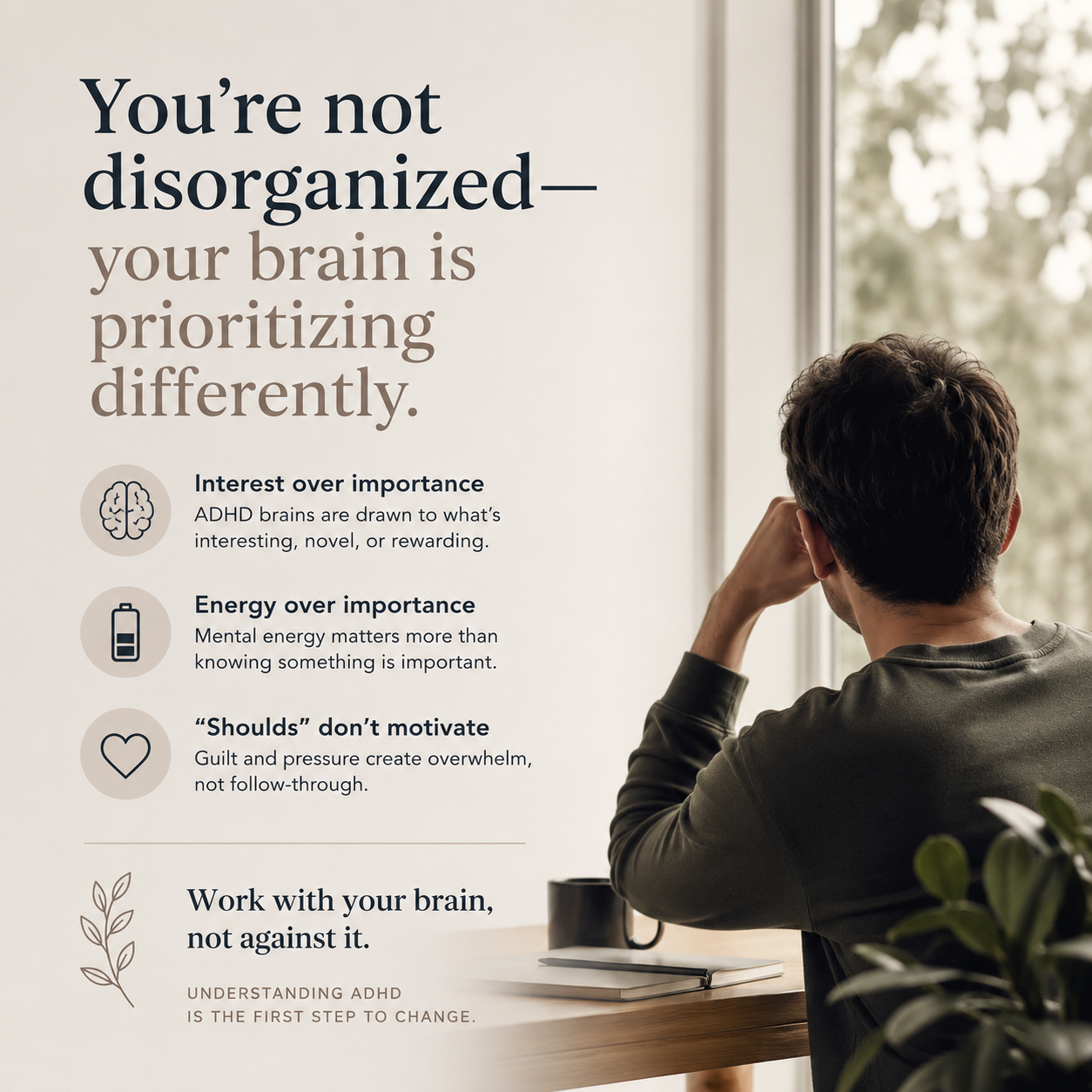
You're Not Disorganized — Your Brain Is Prioritizing Differently
"I know I need to do it. So why can't I just get started?"
If you have ADHD, this question can feel frustrating and confusing.
You know the assignment is due.
You know the email needs to be sent.
You know the paperwork matters.
Yet somehow, your attention drifts elsewhere—into researching something unrelated, reorganizing a space, or avoiding the task altogether.
Many people interpret this as laziness or lack of discipline.
But what if the issue isn’t organization at all?
What if your brain is prioritizing differently?
ADHD Is Not a Lack of Motivation
A common misconception is that ADHD reflects a lack of care or effort.
Research consistently shows the opposite. Many individuals with ADHD care deeply and often experience significant stress about unfinished tasks and responsibilities.
ADHD primarily affects executive functioning—skills responsible for planning, task initiation, working memory, emotional regulation, and follow-through.
This means the challenge is not knowing what to do.
It’s accessing the ability to do it at the right time.
The Interest-Based Nervous System
ADHD has been described by researchers, including Dr. Russell Barkley, as a condition where performance is influenced more by immediate interest than by importance.
Attention is more easily activated by tasks that are:
Novel
Personally meaningful
Urgent or time-sensitive
Emotionally engaging
Immediately rewarding
This helps explain why someone can hyperfocus for hours on certain activities while struggling to begin a simple, low-stimulation task.
This is not a character flaw. It reflects differences in dopamine regulation and motivation pathways in the brain.
Why Energy Often Matters More Than Importance
For individuals with ADHD, task completion is strongly tied to available mental energy—not just priority.
Factors that significantly impact executive functioning include:
Sleep quality
Stress levels
Emotional load
Burnout
Decision fatigue
When these are depleted, even small tasks can feel inaccessible.
What looks like procrastination from the outside often feels like paralysis from the inside.
This aligns with cognitive and behavioral research showing that task initiation improves when cognitive load is reduced and environments are structured for success.
Why “Should” Backfires
Many people with ADHD rely on self-criticism to try to stay on track:
"I should just do it."
"I should be better at this."
"I should have figured this out by now."
However, evidence from cognitive behavioral therapy (CBT) shows that shame and self-criticism reduce motivation over time and increase avoidance.
Repeated cycles of perceived failure can contribute to:
Anxiety
Low self-worth
Perfectionism
Avoidance patterns
Burnout
Sustainable change comes from understanding, not pressure.
A Social Work Perspective: Looking at the Whole System
From a social work lens, ADHD is not just an individual issue—it is shaped by environment, expectations, and systems.
We consider:
How school or workplace demands may not align with neurodivergent functioning
The impact of past criticism or misunderstanding
Cultural and family expectations around productivity
Access to supports and accommodations
ADHD also commonly co-occurs with anxiety, depression, and trauma-related responses, which can further affect focus and task initiation.
A holistic approach means we are not asking, "Why aren’t you trying harder?"
We are asking:
What supports are missing?
What patterns are keeping you stuck?
What strengths can we build on?
Evidence-Based Strategies That Actually Help
Instead of relying on willpower alone, research supports strategies that reduce friction and increase engagement:
Break tasks into very small, clearly defined steps (behavioral activation)
Use external structure (timers, reminders, body doubling)
Pair tasks with stimulation (music, movement, novelty)
Lower the “start barrier” (commit to 2–5 minutes instead of the full task)
Use visual cues and environmental design to reduce decision-making
Build routines around energy patterns, not ideal schedules
In some cases, medication can also play a role by improving attention and executive functioning. Therapy can help integrate these tools into daily life in a sustainable way.
Work With Your Brain, Not Against It
If you have ADHD, struggling to start does not mean you are lazy.
Forgetting things does not mean you don’t care.
Feeling overwhelmed does not mean you are incapable.
It means your brain responds differently to motivation, structure, and energy.
When you understand how your brain works, you can stop fighting against it—and start building systems that support you.
Looking for Support?
Living with ADHD can feel exhausting, especially if you’ve spent years feeling misunderstood or hard on yourself.
Therapy can help you:
Understand how your brain works
Develop practical, personalized strategies
Reduce shame and self-criticism
Improve follow-through and daily functioning
Navigate anxiety, burnout, or overwhelm
You don’t need to work harder.
You may need a different approach—and the right support to implement it.
If you’re in Ontario and looking for ADHD-informed, practical, and compassionate therapy, I offer virtual sessions designed to meet you where you are and in Person in London and surrounding areas.
