
The Athlete Behind the Behaviour: What Coaches and Parents Need to Understand
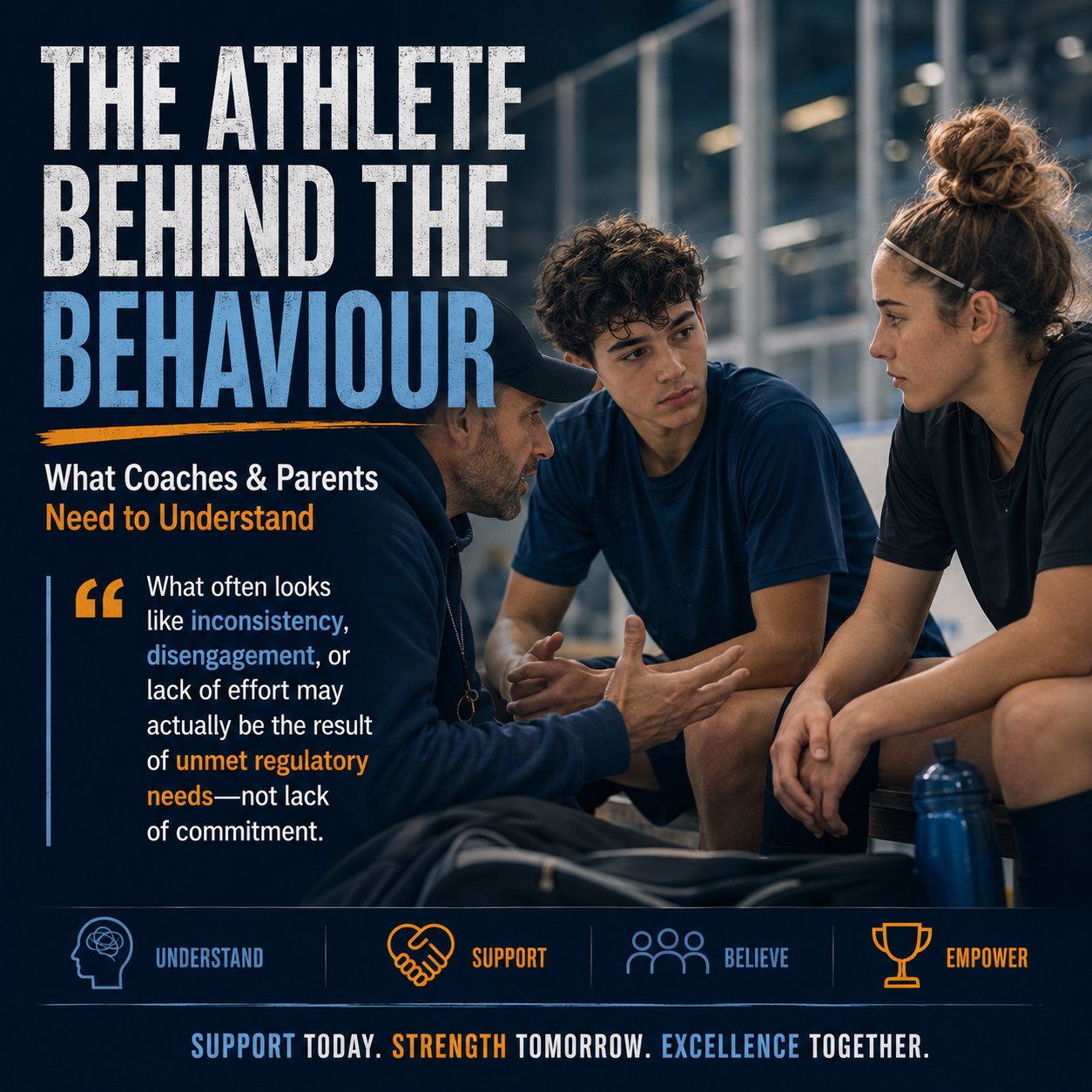
What often looks like inconsistency, disengagement, or lack of effort may actually be the result of unmet regulatory needs—not lack of commitment.
In the previous article, we explored how fairness in sport is often defined through sameness—but how equal treatment does not always create equitable opportunity.
This distinction becomes even more important when we look at the people closest to neurodivergent athletes: parents and coaches.
Because in high-performance environments, it is not only systems that shape outcomes.
It is interpretation.
How behaviour is understood often determines whether an athlete is supported, penalized, or slowly pushed out of the sport they are fully capable of succeeding in.
Many parents of neurodivergent athletes find themselves walking a difficult line.
They want to advocate for their child—who they know is capable of competing at a high level—but they fear being labeled as “difficult” or “that parent.”
So they stay quiet.
Or they watch their child begin to lose confidence as missed practices, burnout, anxiety, or sensory overwhelm are interpreted as lack of commitment.
No parent is asking for their child to be given an advantage.
They are asking for equitable conditions—so their child has a fair opportunity to perform at the level they are capable of.
Because equal does not always mean equitable.
Coaches Have More Influence Than They Realize
At the competitive level, coaches shape not only performance—but identity.
When athletes repeatedly hear:
“If you’re not at practice, you don’t play.”
“Everyone is treated the same.”
“Life isn’t fair.”
They may begin to internalize:
“I’m unreliable.”
“I’m not cut out for this level.”
“I don’t belong here.”
This is how capable, high-performance athletes begin to disengage.
Not because they lack talent.
But because the environment does not recognize how they access that talent.
When coaches take a different approach—one that maintains accountability while allowing for flexibility—the message changes:
“You belong here.”
“We can support your performance.”
“Your differences are not weaknesses.”
For many neurodivergent athletes, those differences are also the source of their strengths.
The same intensity, focus, creativity, and persistence that can make sport challenging can also make them exceptional competitors.
Inclusion Is More Than Participation
True inclusion in high-performance sport is not about participation alone.
It is about creating environments where athletes can sustain performance, build confidence, and continue developing over time.
Because when neurodivergent athletes are supported appropriately, they do not just keep up.
They often excel.
Not despite their differences.
But because of them.
This concludes the series.
If you’ve read through all four articles, you now have a full picture of how neurodivergence, environment, fairness, and leadership intersect in competitive sport.
👉 Explore more resources on neurodivergent athletes in high-performance environments on the site
👉 Or revisit the full series to share with coaches, parents, or sport organizations
Contact me if you would like to setup a session
