
Proactive vs. Reactive Athletes: The Mental Shift That Changes Performance
You don’t lose confidence because of one mistake.
You lose it because of what happens next.
One missed shot.
One bad call.
One turnover.
And suddenly, you’re not playing to win—you’re playing not to mess up.
If that feels familiar, you’re not alone.
And more importantly, it’s not a talent issue.
It’s a mindset pattern.
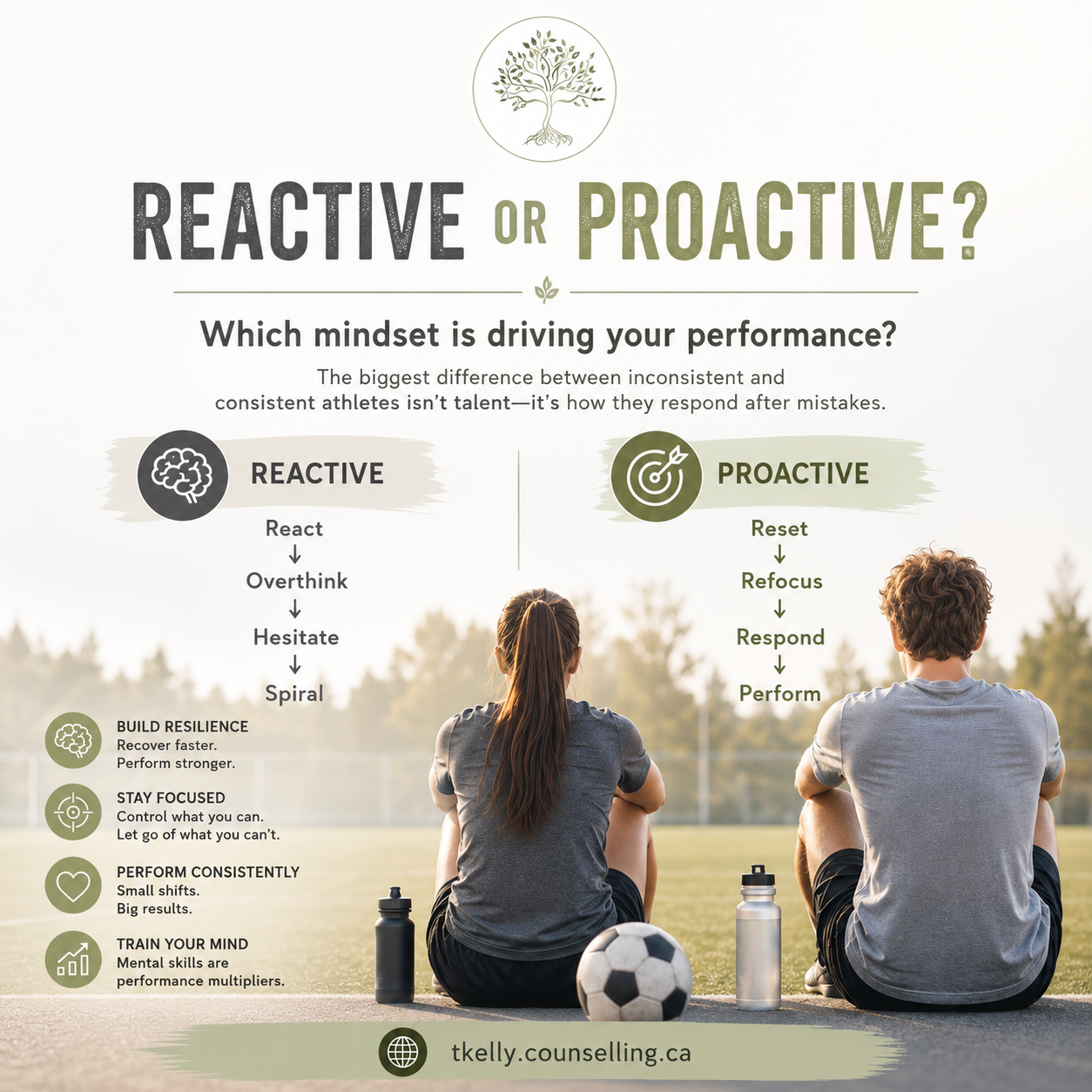
In high-performance athletes, the biggest difference between inconsistent and consistent performance often comes down to one thing:
Are you competing reactively… or proactively?
When the Game Starts Controlling You
Picture this:
You miss an open net.
Instantly your mind shifts:
“I should have scored.”
“Coach is going to notice.”
“I need to make up for it.”
From that moment on, your game changes:
You hesitate instead of trusting your instincts
You force plays that aren’t there
You stop communicating
You overthink every decision
The mistake happened once.
But mentally, it keeps happening.
That’s reactive performance.
And it’s one of the biggest performance drains in sport.
Reactive Athletes: Why Performance Feels Unstable
Reactive athletes let external factors control their internal state.
Their confidence depends on:
The scoreboard
Their last play
A coach’s reaction
Officiating decisions
Playing time
The crowd or social media
The result?
They’re constantly adjusting emotionally instead of competing intentionally.
And that costs focus, energy, and execution.
Proactive Athletes: The Consistency Advantage
Proactive athletes don’t rely on things going perfectly.
They expect:
Mistakes
Pressure
Uncertainty
And they prepare for all three.
Instead of reacting, they reset.
Instead of spiraling, they refocus.
Instead of chasing the last play, they commit to the next one.
That’s why they look more consistent—even under pressure.
The Truth About Confidence in Sport
Here’s what most athletes get wrong:
Confidence is not something you maintain.
It’s something you rebuild—over and over again.
Elite athletes don’t stay confident all game.
They just recover faster:
Faster emotional reset
Faster return to focus
Faster decision-making
Resilience is not about avoiding mistakes.
It’s about how quickly you move past them.
The One Question That Changes Everything
After a mistake, most athletes ask:
“Why did that happen?”
High-performing athletes ask:
“What can I control right now?”
That single shift redirects your brain from emotional reaction to intentional action.
You can’t control:
The referee
Your opponent
The last play
Your coach’s decisions
You can control:
Your effort
Your communication
Your breathing
Your body language
Your next decision
That’s where performance stability comes from.
A Note for Neurodivergent Athletes
For athletes with ADHD, OCD, Tourette syndrome, autism, or anxiety, this shift can be more complex—but just as trainable.
Pressure can feel louder.
Mistakes can stick longer.
Focus can be harder to regain.
That’s not a weakness. It’s a difference in processing.
The goal isn’t to eliminate thoughts or emotions.
It’s to build reliable reset systems that bring you back to the present—faster.
With the right strategies, proactive performance is absolutely achievable across all neurotypes.
Mental Skills Are Trainable (And Often Overlooked)
Most athletes train physical skills daily—but neglect the mental side.
That’s a missed opportunity.
Because confidence, focus, and composure are built through:
Pre-performance routines
Reset strategies after mistakes
Breathing and regulation techniques
Performance-focused self-talk
Attention control under pressure
These are not “extras.”
They are performance multipliers.
If You Feel Stuck in Your Own Head…
You’re not alone—and you’re not the problem.
Many athletes don’t need more effort.
They need a better mental framework.
The shift from reactive to proactive is often where athletes unlock:
More consistent performance
Stronger confidence
Better emotional control
Greater enjoyment in sport
Ready to Train the Mental Side of Your Game?
If you’re tired of:
Overthinking after mistakes
Losing confidence mid-game
Feeling inconsistent despite your ability
Mental performance training can help.
At Theresa Kelly Counselling, I work with athletes (16+) to build:
Confidence under pressure
Emotional regulation
Focus and attention control
Resilience and recovery skills
I also specialize in supporting neurodivergent athletes, including ADHD, OCD, Tourette syndrome, and autism.
If you’re ready to spend less time reacting—and more time performing—book an appoin.
