
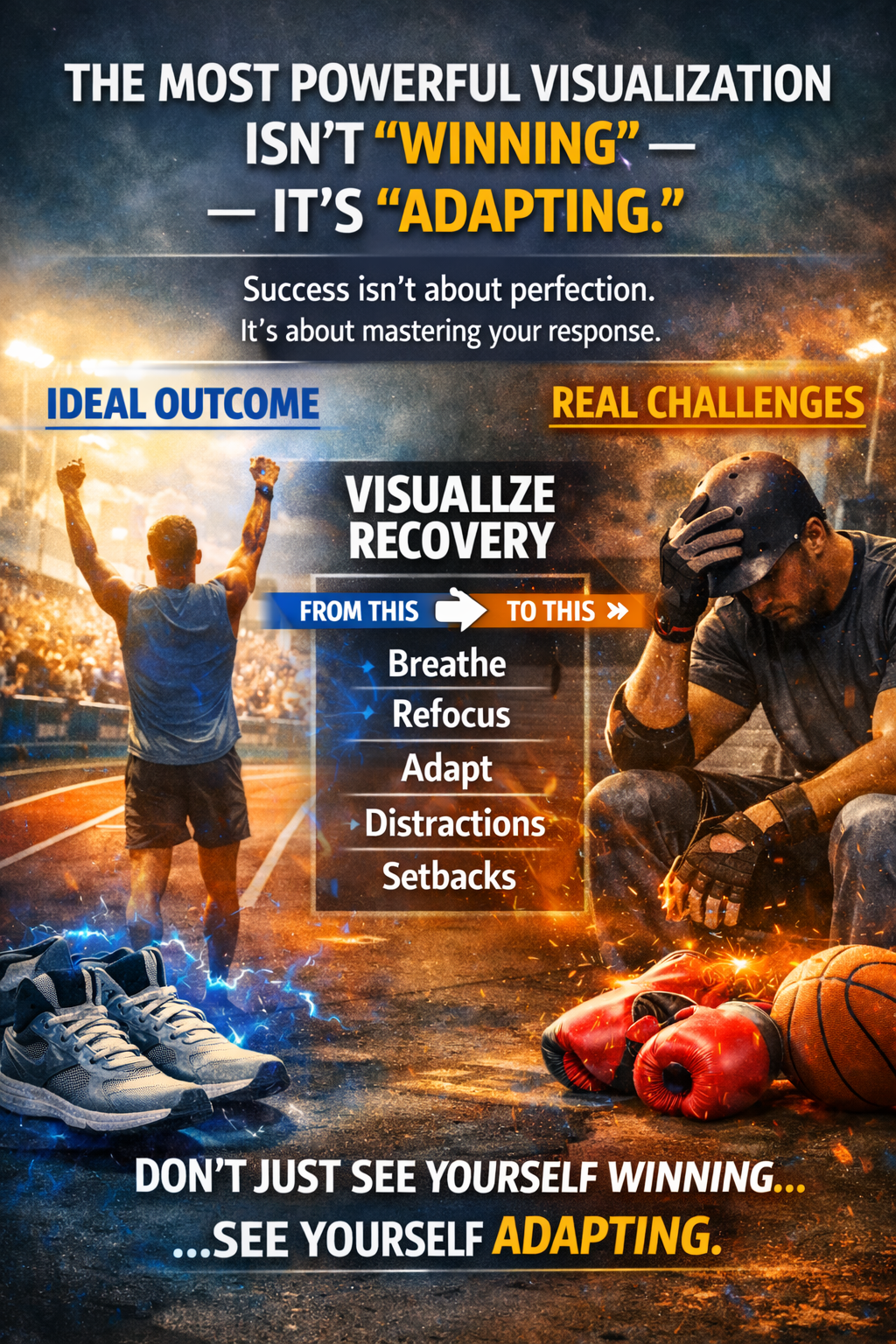
The Most Powerful Visualization Isn’t “Winning” — It’s Adapting
You’ve probably heard it before: “See yourself winning.”
Close your eyes. Picture perfection. Imagine applause. Imagine success.
Sounds motivating. Feels powerful.
But here’s the truth: overly positive visualization often fails when reality gets messy.
Why “See Yourself Winning” Isn’t Enough
When your mental rehearsal only shows perfect outcomes, you’re building a fragile script.
In your mind, everything flows. You are confident. Calm. Precise. Nothing goes wrong.
Then real life happens:
You stumble over your words.
Your heart races.
Someone challenges you.
You forget something important.
And if your mind never practiced these moments? You spiral.
The Secret of Elite Performers
Research shows that effective visualization isn’t just about success—it’s about process, coping, and adversity.
Elite performers don’t just rehearse winning. They rehearse disruption.
They imagine:
Crowds getting loud
Technology failing
Opponents taking the lead
Criticism landing
Mistakes happening
And then they visualize recovery:
Breathing
Refocusing
Adjusting
Continuing anyway
This is called coping imagery.
Not pretending adversity won’t happen—practicing how to respond when it does.
Pressure-Based Imagery
Want to go further? Imagine stakes are high:
Time is short
Eyes are on you
Fatigue is real
Mistakes are possible
Feel your heart rate rise. Feel tension. That discomfort teaches your nervous system: activation ≠ danger.
Performance breaks down when pressure feels unfamiliar. It stabilizes when pressure feels rehearsed.
Practice Mistakes, Practice Recovery
If your visualization never includes mistakes, you’re not preparing—you’re fantasizing.
Forget a line. Lose momentum. Start poorly. Receive negative feedback.
Then visualize recovery:
What do you say to yourself?
What action do you take?
How do you reset?
How do you keep going?
Resilience isn’t built by imagining perfection. It’s built by imagining imperfection—and mastering your response.
The Takeaway
The most powerful visualization isn’t:
“I see myself winning.”
It’s:
“I see myself adapting.”
Add friction. Add emotion. Add pressure. Visualize mistakes. Visualize recovery.
Because performance isn’t about avoiding disruption—it’s about mastering your response to it.
