
Stop Relying on Confidence: The System Elite Athletes Use Instead
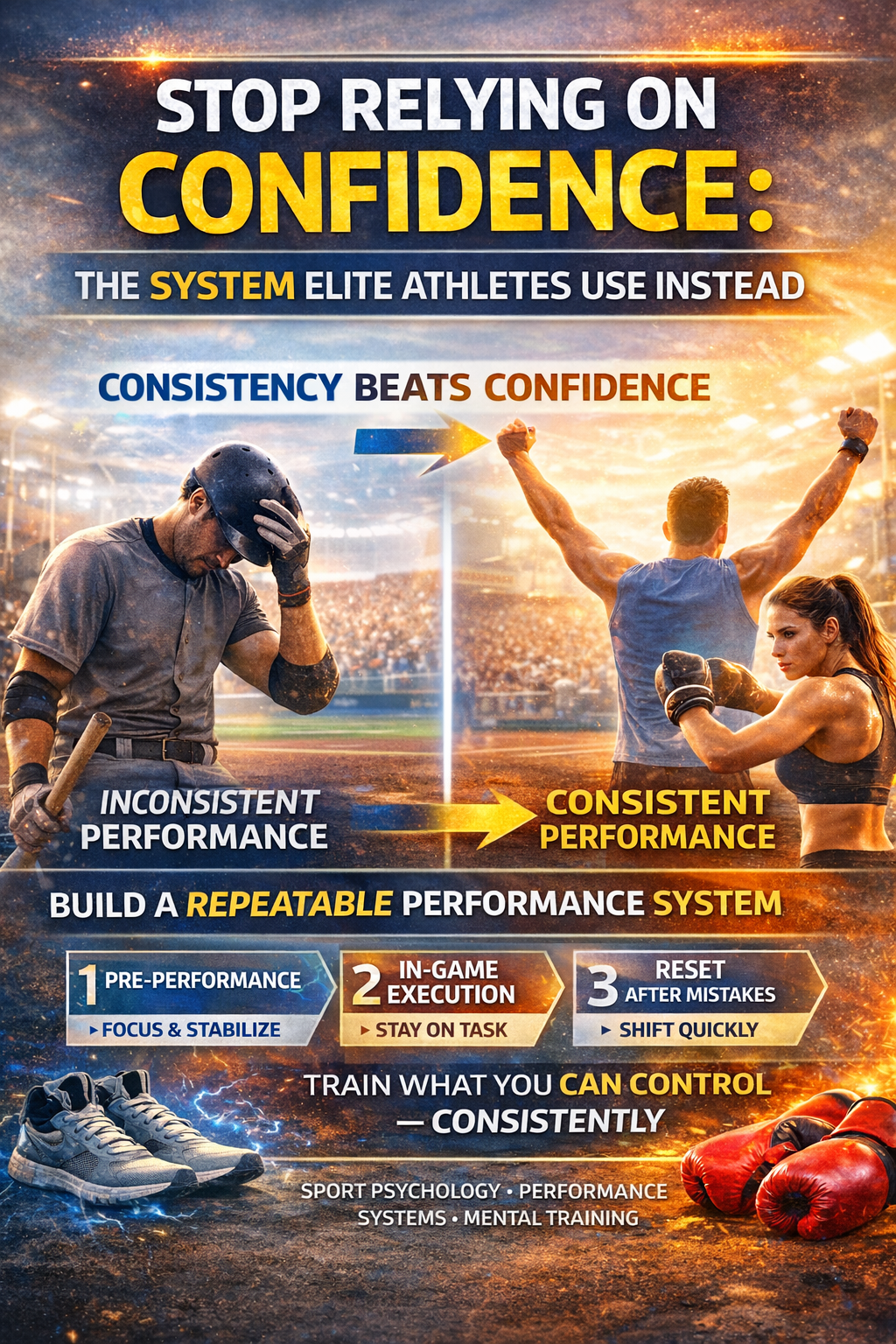
“Consistency beats confidence.”
Because confidence is a feeling.
And feelings don’t hold up under pressure.
The Real Problem Isn’t Confidence — It’s Variability
Most athletes aren’t struggling because they lack confidence.
They’re struggling because their performance is inconsistent.
Strong in practice, inconsistent in games
Great one day, off the next
Solid until one mistake — then everything unravels
That’s not a confidence issue.
That’s a lack of a repeatable performance system.
Why Confidence Fails You in Competition
Confidence is:
Fluctuating
Emotion-dependent
Highly reactive to outcomes
Research in sport psychology shows that performance drops under pressure when athletes rely on internal states (like confidence) rather than task-relevant processes (Eysenck et al., 2007).
When you think:
“I need to feel confident”
You shift attention inward.
And that’s exactly what disrupts:
Reaction time
Decision-making
Skill execution
What Elite Athletes Do Differently
They don’t ask:
“Do I feel ready?”
They rely on:
“What is my system right now?”
Because systems:
Reduce decision fatigue
Anchor attention
Create automatic execution under stress
This is supported by research on automaticity and motor performance, showing that well-learned, routine-driven actions are more resistant to pressure (Beilock & Carr, 2001).
The Shift: Systems > Emotion
Instead of chasing a mental state, elite performers build:
Pre-performance routines
In-game reset strategies
Task-focused attention cues
These create consistency — regardless of confidence level.
What a Performance System Actually Looks Like
This isn’t just “have a routine.”
It’s a structured mental framework used before, during, and after performance.
1. Pre-Performance System (Before the Game)
Purpose: Stabilize focus and reduce variability
Same warm-up sequence every time
Controlled breathing to regulate arousal
1–2 clear performance cues
👉 Outcome: You start from a predictable mental state, not a random one
2. In-Game System (During Performance)
Purpose: Maintain execution under pressure
Narrow focus to controllable actions
Use cue words (“quick,” “strong,” “next”)
Avoid outcome-based thinking
👉 Outcome: Attention stays on execution, not emotion
3. Reset System (After Mistakes)
Purpose: Prevent downward spirals
Brief physical reset (e.g., step back, adjust gear)
One breath
Immediate cue: “next play”
Research shows that rapid attentional shifting is key to maintaining performance after errors.
👉 Outcome: Mistakes don’t compound
Why This Works (The Science)
Attentional Control Theory: Performance improves when focus stays on task-relevant cues
Cognitive Load Theory: Systems reduce mental overload under stress
Motor Learning Research: Automatic, practiced behaviors are more resilient in pressure environments
Together, this explains why:
👉 Structure outperforms emotion — every time
What Athletes Get Wrong
They try to:
Build confidence
Stay positive
“Get in the zone”
But those are outcomes, not skills.
Without a system, those states are:
Inconsistent
Unreliable
Untrainable on demand
What Actually Improves Performance
Training:
Focus control
Reset routines
Consistent execution patterns
That’s what creates:
Stability
Repeatability
Trust in performance
If you want to perform consistently — not just when things feel right —
you need more than confidence.
You need a system that works under pressure.
👉 Train what you can control.
If you’re an athlete, parent, or coach looking to build consistent, high-level performance, sport psychology can help you develop a custom performance system tailored to your sport and position contact me for an appointment
