
Why Your Teen or Young Adult with ADHD Looks Lazy — But Isn’t
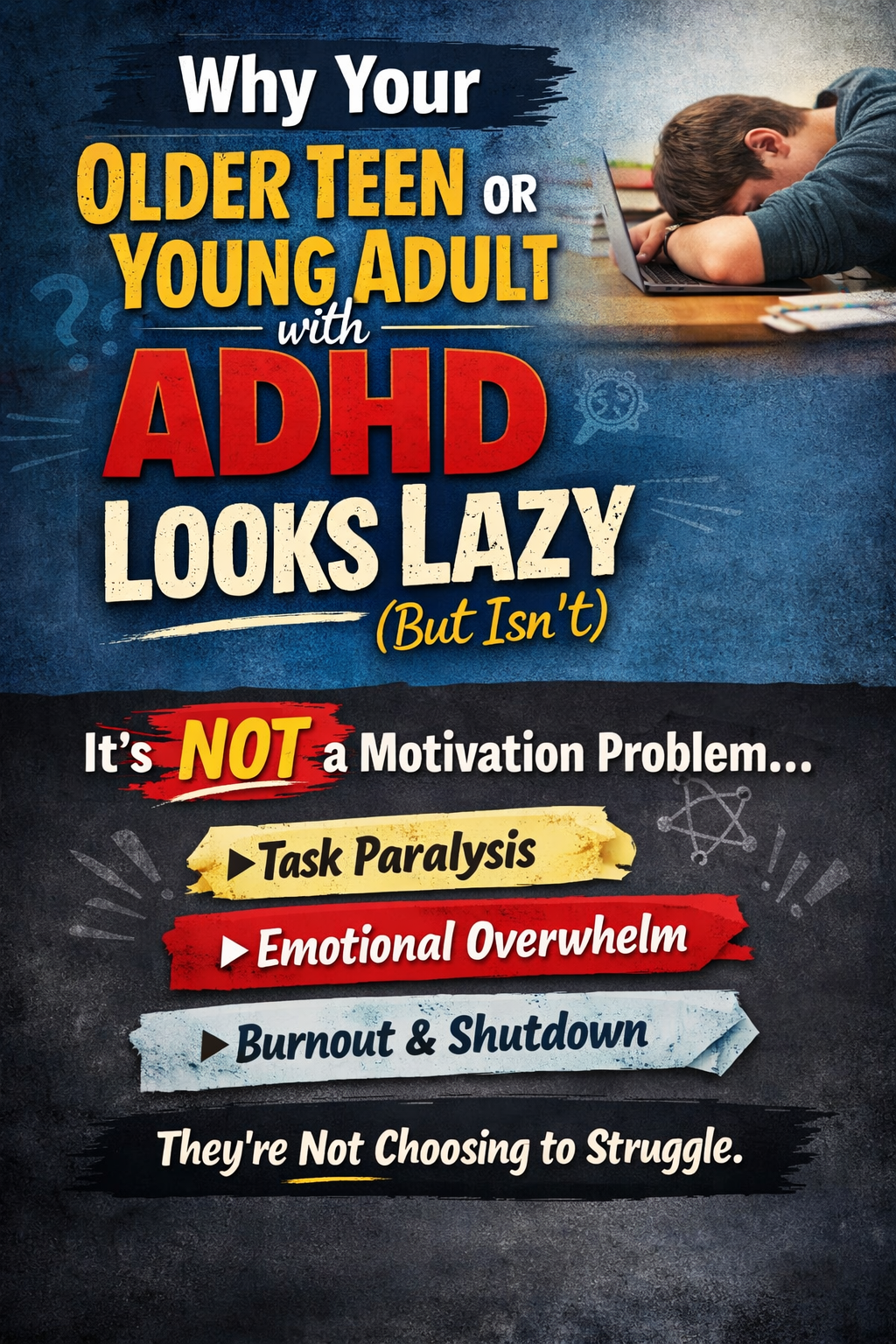
If you’re parenting a teen or young adult with ADHD, you’ve probably wondered:
“They’re capable… so why aren’t they doing it?”
It’s one of the most frustrating parts of this stage — and one of the most misunderstood.
Here’s the truth: ADHD is not a motivation problem.
It’s a challenge of performance, executive functioning, and regulation.
Research consistently shows that ADHD affects the brain’s ability to start, plan, and complete tasks even when motivation and intention are high. Your teen likely knows what needs to be done — they just can’t get their brain to do it on demand.
Understanding ADHD Motivation (and Why It Looks Like Laziness)
For older teens and young adults, ADHD often shows up as behaviors that can easily be mistaken for laziness or defiance. You might see:
Chronic procrastination or avoidance
Starting things late (or not at all)
Emotional shutdown or irritability
Inconsistency — “They could do it yesterday, why not today?”
Burnout from trying to keep up
These patterns aren’t about not caring. They’re about how their brain manages initiation, focus, and recovery from stress.
The Pattern Parents Get Pulled Into
When frustration builds, parents often try harder to motivate — more reminders, more pressure, more consequences.
But that pressure often triggers avoidance, shame, or shutdown, leading to the cycle:
Pressure → Shutdown → Conflict → Guilt → Repeat
Over time, your teen may start to believe, “I’m just lazy” or “I’ll never get it right.”
What Actually Helps (and Builds Independence)
Shift from control to collaboration
Instead of: “Why didn’t you do it?”
Try: “What’s getting in the way of starting?”Break tasks down further than feels natural
“Start your assignment” might be too big.
Try: “Open your laptop” as a first step.Focus on starting, not finishing
Momentum matters more than completion when activation is hard.Regulate first, problem-solve second
No one can think clearly in emotional overload. Help them reset first.Be their safe base
Even if they seem to push you away, your calm presence helps them regain stability.
The Piece Most Parents Miss
Your teen or young adult likely already feels like they’re failing — even if they hide it behind indifference or irritation. When they feel understood instead of judged, it opens the door for growth and accountability.
The Reframe That Changes Everything
They’re not giving you a hard time.
They’re having a hard time.
And with the right tools and support, they can learn to manage ADHD more effectively.
For Parents Who Want Support
If this sounds like your family, you don’t have to figure it out alone.
👉 Contact me for an appointment — let’s make a plan that fits your teen’s brain, not just their to-do list.
As an ADHD coach supporting families in London, Ontario and beyond, I help parents turn frustration into understanding — and connection into progress.
