
ADHD Makes Time Feel Fake — Here’s Why You Can’t “Just Start”
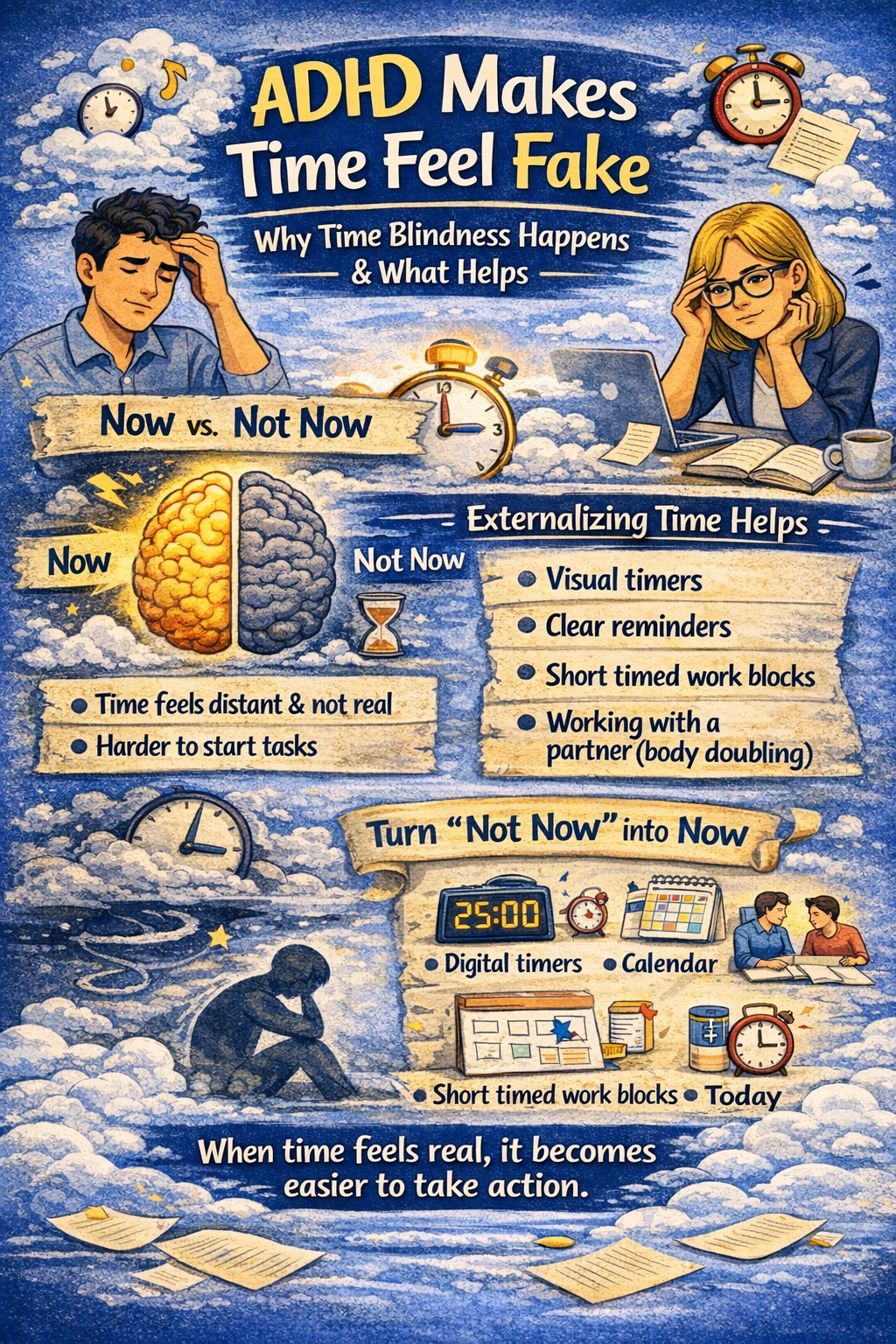
ADHD Makes Time Feel Fake
If you work with or live with ADHD, you’ve probably heard something like:
“I know it’s due… I just can’t feel it yet.”
That’s not laziness.
That’s not a lack of care.
It’s how ADHD changes the way time is experienced.
Why Time Feels So Different with ADHD
Many people with ADHD struggle with something called time blindness — difficulty accurately sensing the passage of time or prioritizing future events.
Instead of time feeling like a steady flow, it often feels split into two categories:
Now
Not now
If something is happening now, it’s real, urgent, and actionable.
If it’s not now — even if it’s tomorrow, later today, or in a few hours — it can feel distant, abstract, and easy to disconnect from.
This isn’t a mindset issue.
It’s linked to differences in executive functioning and dopamine regulation, which affect planning, motivation, and anticipation.
The “Now vs. Not-Now” Brain
In ADHD, the brain is less responsive to delayed rewards and future consequences.
That means:
Starting early feels harder
Planning ahead feels less urgent
Long-term tasks feel disconnected
But when something becomes immediate — when it shifts into “now” — everything changes.
Why Deadlines Suddenly Create Focus
You’ve probably seen this pattern:
A task sits untouched for days or weeks…
Then suddenly, right before the deadline, focus kicks in.
This isn’t random.
As urgency increases, so does dopamine and arousal, which helps the brain:
engage attention
prioritize the task
filter out distractions
In other words, the brain finally gets the signal:
“This matters right now.”
That’s why many individuals with ADHD can perform exceptionally well under pressure — but struggle to start before that pressure exists.
The Problem Isn’t Motivation — It’s Timing
Traditional advice often sounds like:
“Just start earlier”
“Break it down”
“Be more disciplined”
But if the brain doesn’t register something as now, those strategies often fall flat.
This can lead to:
frustration
self-doubt
feeling “inconsistent” or “unreliable”
When in reality, the issue is how time is being processed, not effort.
What Actually Helps
Research and clinical practice consistently show that externalizing time is one of the most effective supports for ADHD.
This means making time:
visible
concrete
immediate
Examples include:
visual timers or countdowns
breaking tasks into short, timed work blocks
setting artificial deadlines before the real one
working alongside someone else (body doubling)
using reminders that interrupt and refocus attention
These strategies help shift tasks from “not now” into “now.”
Why This Matters
When time becomes more tangible, everything changes:
tasks feel easier to start
overwhelm decreases
follow-through improves
And perhaps most importantly —
people begin to feel more in control of their day.
Final Thought
ADHD doesn’t mean someone doesn’t care about their responsibilities.
It often means their brain needs different ways of interacting with time.
Call to Action
External time supports can make a significant difference — but they work best when tailored to the individual.
If you’re noticing patterns like last-minute stress, difficulty starting tasks, or inconsistent follow-through, it may not be about effort — it may be about how time is showing up.
Learning how to work with your brain, instead of against it, can change everything. Contact me for an appointment.
