
ADHD, Identity, and Self-Trust: Rebuilding Confidence After Years of Self-Doubt
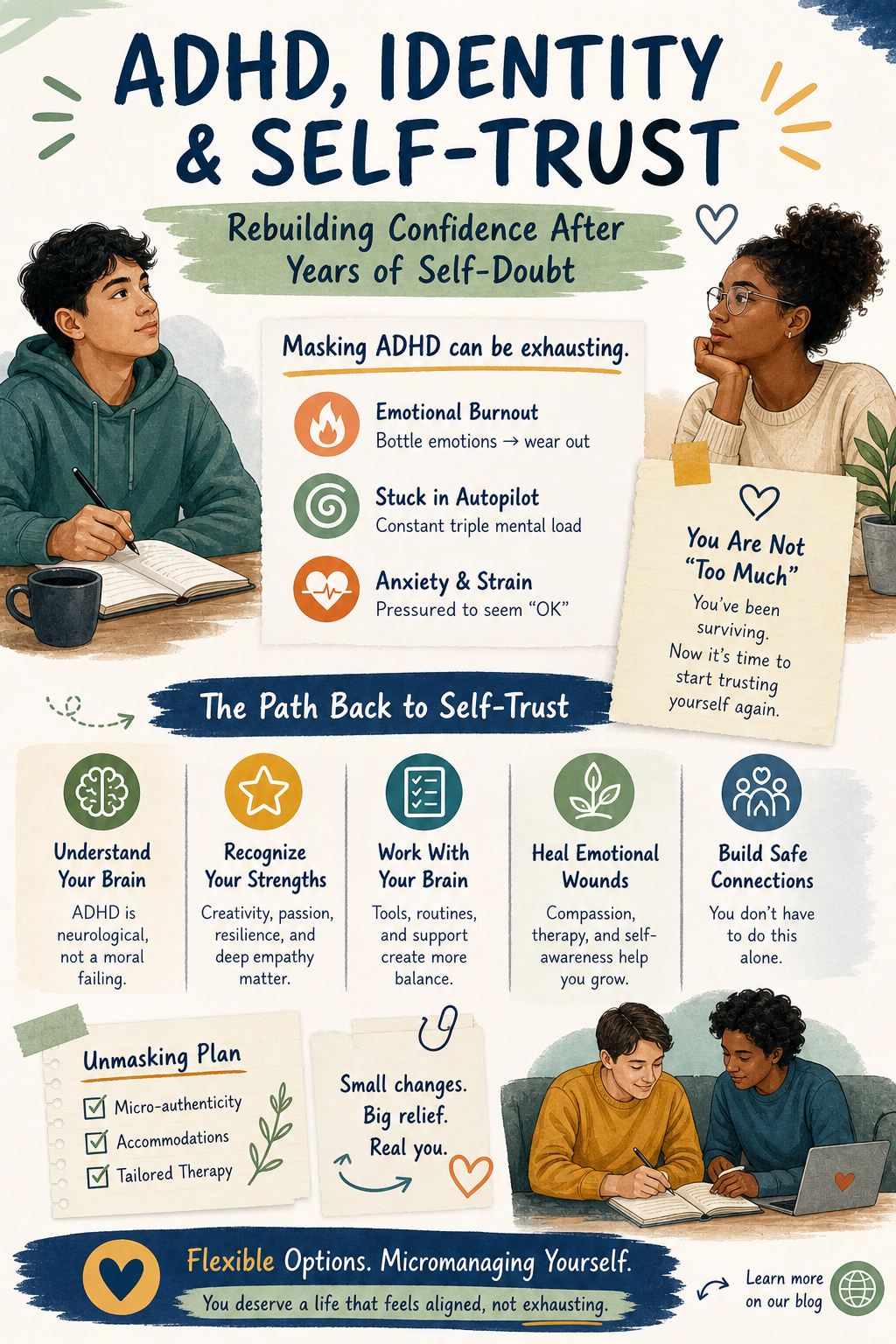
Many teens and adults with ADHD don’t just struggle with focus—they struggle with how they see themselves.
Years of criticism, inconsistency, and overwhelm can quietly erode self-trust.
This post explores how ADHD impacts identity—and how to begin rebuilding confidence.
There’s a version of ADHD that people don’t talk about enough.
Not the distractibility.
Not the unfinished laundry piles.
Not the “squirrel brain” jokes on social media.
The quieter side of ADHD is what happens internally after years of feeling like you are constantly falling short.
For many teens and adults with ADHD, the deeper struggle is not attention. It is identity.
It is growing up hearing:
“You have so much potential.”
“Why can’t you just try harder?”
“You’re lazy.”
“You’re careless.”
“You never finish anything.”
“You’re too emotional.”
“You’re irresponsible.”
Over time, these messages don’t just sting—they settle in. What begins as difficulty with executive functioning can slowly turn into chronic self-doubt, shame, and a loss of trust in yourself.
Many individuals with ADHD are not only trying to manage symptoms. They are trying to rebuild a relationship with themselves.
ADHD and the Hidden Impact on Identity
ADHD is often misunderstood as simply a problem with attention or hyperactivity. However, research consistently shows that ADHD affects multiple domains of functioning, including emotional regulation, self-esteem, motivation, relationships, and overall quality of life.
When someone repeatedly experiences:
Missed deadlines
Forgotten responsibilities
Academic or workplace struggles
Impulsive decisions
Emotional overwhelm
Ongoing criticism from authority figures or peers
They may begin to believe there is something fundamentally wrong with them.
This is especially common in individuals whose ADHD was:
Undiagnosed
Misunderstood
Minimized
Or masked for years
Many clients describe feeling like they are:
“too much,”
“not enough,”
“behind everyone else,”
or “faking adulthood.”
Over time, self-trust erodes—not because they lack ability, but because their lived experiences have repeatedly contradicted their intentions.
You Learned to Doubt Yourself for a Reason
Many individuals with ADHD fall into a repeating pattern:
Executive functioning challenges arise
Criticism or perceived failure follows
Shame becomes internalized
Future failure is anticipated
Anxiety and avoidance increase
Functioning becomes even more difficult
Confidence continues to decline
This cycle can contribute to:
Burnout
Perfectionism
People-pleasing
Chronic anxiety
Depression
Masking
Emotional exhaustion
Some individuals respond by overcompensating and becoming high achievers. Others withdraw or shut down because trying feels too costly. Both responses are often rooted in the same fear: failing again.
Why You Still Don’t Trust Yourself
Self-trust is the ability to believe:
“I can follow through.”
“I can handle challenges.”
“My feelings make sense.”
“I can rely on myself.”
“I am capable, even when things are hard.”
For individuals with ADHD, self-trust is often disrupted by inconsistency.
You may care deeply about something, intend to do it, and still struggle to start, organize, prioritize, or complete it. This gap between intention and execution can create intense shame.
Over time, many people begin to question:
Their intelligence
Their reliability
Their emotional responses
Their sense of identity
The issue is not a lack of effort or caring. In many cases, it reflects a nervous system that has been overwhelmed, dysregulated, or operating in survival mode for years.
When Trying Harder Stops Working
Confidence is not built through positive thinking alone.
For many individuals with ADHD, confidence has been shaped by years of lived experience—missed expectations, inconsistent performance, and external criticism. These experiences reinforce the belief that they are incapable or unreliable.
Rebuilding confidence requires more than mindset shifts. It involves:
Understanding ADHD as a neurodevelopmental condition
Recognizing the impact of chronic shame
Creating realistic, repeatable experiences of success
Developing self-compassion
Research suggests that self-compassion is associated with greater emotional resilience and lower psychological distress in individuals with ADHD-related challenges.
Self-compassion allows individuals to separate their worth from their symptoms.
Rebuilding Self-Trust After Years of Self-Doubt
Healing rarely happens through sudden transformation. It often begins with small, meaningful shifts:
“Maybe I’m not lazy.”
“Maybe my brain works differently.”
“Maybe there’s a reason this has been so hard.”
“Maybe I can stop fighting myself.”
1. Understanding ADHD Beyond Stereotypes
Psychoeducation is often a turning point.
Learning about ADHD through an evidence-based, compassionate lens can help individuals reframe years of self-blame. Many people experience a sense of grief when they recognize how long they misunderstood themselves—but also relief in realizing they were never “failing” in the way they believed.
2. Recognizing Strengths That Were Overlooked
ADHD is frequently framed in terms of deficits, but this is only part of the picture.
Many individuals with ADHD demonstrate:
Creativity
Humour
Emotional sensitivity
Strong intuition
Problem-solving abilities
Passion-driven focus
Resilience
Innovation
Recognizing strengths does not erase challenges. It creates balance.
3. Working With Your Brain, Not Against It
Many individuals with ADHD have spent years trying to fit into systems that do not align with how their brain functions.
More supportive approaches may include:
External reminders and visual systems
Body doubling
Movement-based regulation strategies
Flexible routines instead of rigid schedules
Reducing unrealistic expectations
Building in recovery time for cognitive fatigue
The goal is not perfection. It is sustainability.
For example, instead of relying on memory alone, using a visible task board or phone reminders can reduce cognitive load and increase follow-through.
4. Healing Emotional Wounds
ADHD is not just cognitive—it is deeply emotional.
Many individuals carry long histories of:
Embarrassment
Rejection
Criticism
Comparison
Internalized shame
Therapeutic approaches such as CBT, DBT, Narrative Therapy, strengths-based models, and somatic interventions can support individuals in:
Challenging negative core beliefs
Regulating emotional responses
Building self-awareness
Reconstructing identity
This work is not about “fixing” the person. It is about helping them understand themselves more accurately and compassionately.
You Are Not “Bad” at Life
One of the most painful ADHD experiences is knowing what to do and still struggling to do it consistently.
That gap can feel defeating.
But difficulty with executive functioning does not mean you are:
Lazy
Immature
Selfish
Unintelligent
Incapable
You are not “bad” at life.
There is a meaningful difference between:
“I can’t because I don’t care”
and
“I care deeply, but I am overwhelmed, dysregulated, or stuck.”
The Role of Safe Relationships
Self-trust is rarely rebuilt in isolation.
Supportive, non-judgmental relationships can help repair the internal belief that someone is “too much” or “not enough.” Whether through therapy, friendships, family, or community, being understood without criticism can create meaningful shifts in identity.
Many individuals with ADHD have spent years masking their struggles. Being able to show up authentically—and still feel accepted—can be deeply healing.
Final Thoughts
Rebuilding self-trust after years of self-doubt takes time.
Especially if you have spent much of your life believing you were failing at things that seemed easy for others.
But healing does not come from becoming a different person or forcing yourself to try harder.
It comes from understanding your brain, responding to yourself with compassion, and slowly rebuilding trust through consistent, supportive experiences.
ADHD does not define your worth.
And struggling does not erase your strengths.
Sometimes the first step in rebuilding confidence is realizing that you were never broken to begin with.
If you’re ready to start rebuilding your confidence and work with your brain instead of against it, ADHD-informed support can help. Contact me and book your appointment.
